A Hero Can Be Formidable and Still Reach Out a Hand
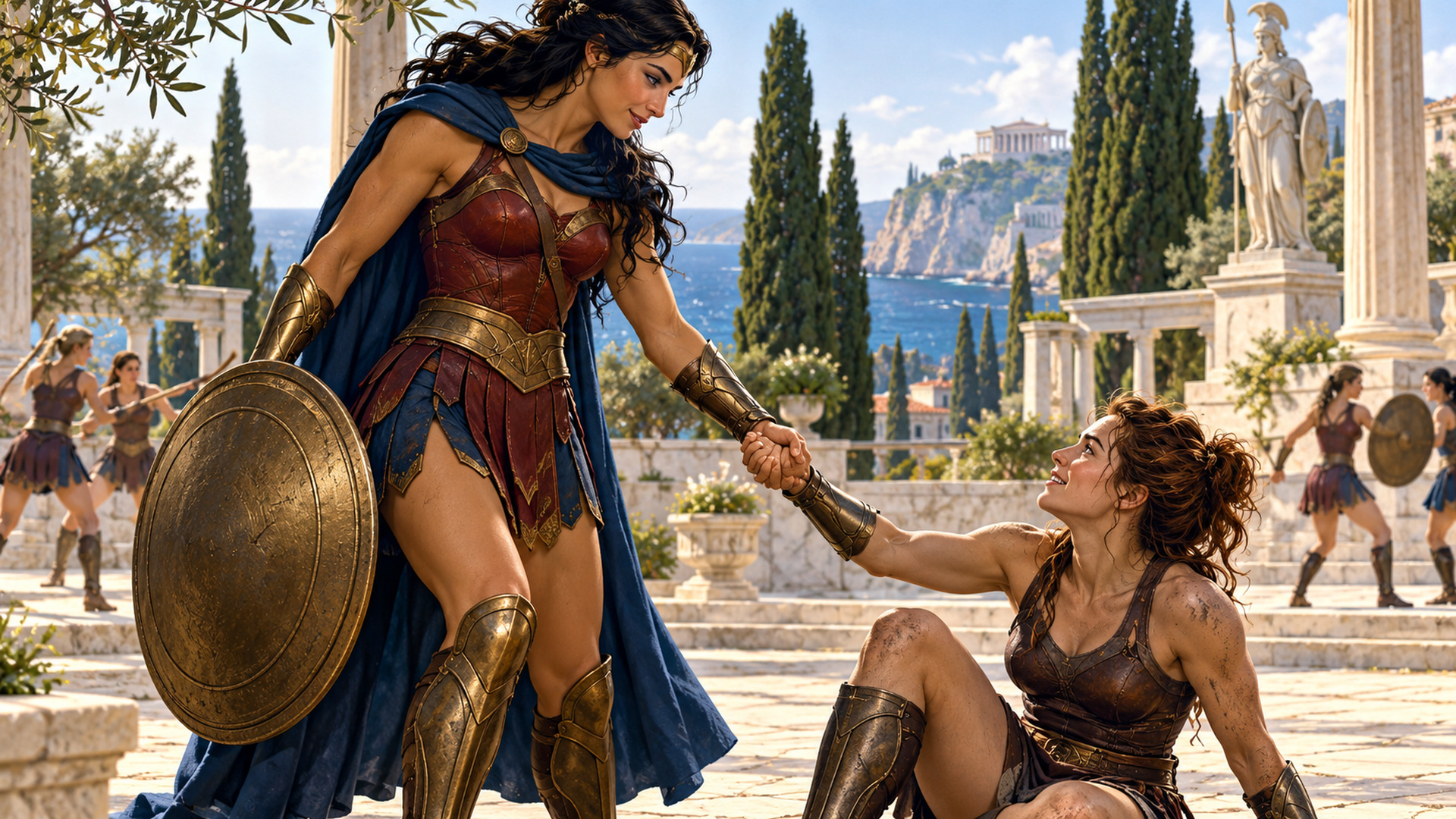
Wonder Woman’s most revealing gesture is not always a strike. Diana can confront an overwhelming threat and then offer understanding, protection, or a way back from violence without losing the authority that made the confrontation possible. That combination helps explain a legacy larger than a famous costume. Since her 1941 debut, the character has placed a woman at the center of adventures about power, truth, responsibility, and the possibility of a different social order. Her Amazon upbringing supplies a community behind those ideas, while successive creative teams have tested what they mean in a changing world. The history is uneven and sometimes contradictory, but its central imaginative offer remains expansive: female strength can determine the course of a story, express values of its own, and coexist with care, curiosity, anger, joy, and difficult judgment.
A: Earlier female comic heroes existed; her distinctive importance includes the durability and reach of her starring premise.
A: It gives capability, institutions, and values a community that Diana can learn from and question.
A: A compassionate character can still act forcefully against cruelty while exercising judgment.
A: Its association with truth can make recognition and deception part of the action.
A: Different continuities revise that part of the mythology, so the relevant account should be identified.
A: It offers an influential modern framework for the Amazons, gods, and Diana's arrival.
A: Each interpretation emphasizes particular possibilities within a much longer publishing history.
A: A wider Amazon world can contain several authoritative perspectives rather than one representative life.
A: Her influence can create room for different temperaments, roles, and genres rather than a compulsory model.
A: Specific choices about protecting, listening, and acting let readers see what her values actually do.
A Durable Female Center in Superhero Publishing
William Moulton Marston and artist H. G. Peter established Wonder Woman in an early superhero landscape dominated by famous male leads. Her debut in All-Star Comics #8 supplied more than another useful member of a group. Diana had a world, a mission, and a visual identity capable of organizing her own adventures. She was not the first female comic hero, and calling her that would obscure earlier work. Her distinctive achievement is the durability and reach of a premise in which a woman’s interpretation of strength and society remains central across generations of publication.
The Amazons Give Strength a Social Origin
The Amazon setting changes the question of why Diana is capable. She comes from a society in which women teach, govern, train, remember, disagree, and build institutions. Ability does not appear only as the unlikely exception of one woman who somehow escaped the limits everyone else accepts. It has a community and a history behind it.
That premise offers more than a convenient origin location. It creates a perspective from which Diana can assess practices that the wider world treats as inevitable. If a social order is learned rather than natural, another arrangement becomes imaginable. Her arrival can therefore challenge assumptions as well as introduce a powerful visitor.
The strongest versions also let the Amazons be people rather than a flawless explanatory device. They can carry traditions that deserve criticism, make difficult decisions, and argue about change. A community capable of imperfection gives Diana something to learn from and something to question, making her relationship with home more interesting than automatic agreement.
Leaving Home Is an Ethical Journey
Diana’s movement into the wider world turns upbringing into action. Values that seem clear within a familiar community meet people whose fears and obligations are different. The resulting story can ask what it means to carry convictions across a border without assuming that possessing those convictions settles every encounter.
This makes listening part of the adventure. Diana can be confident without knowing everything about the society she enters. An effective portrayal allows her to defend what matters while learning from people outside her own experience. That relationship between conviction and openness gives the female superhero a role larger than proving she can succeed at an existing contest.
The Lasso Makes Truth Part of the Action
The lasso is especially revealing because it gives a symbolic value a physical presence on the page. A confrontation can involve deception, recognition, or an unwillingness to face a fact, not merely the amount of force a person can withstand. Its precise abilities vary across stories, but its association with truth creates a recognizable ethical vocabulary. Diana’s equipment can therefore announce what an adventure is interested in before a speech explains it. The important question is how a particular story uses that possibility, rather than whether an object automatically makes its user’s every judgment correct.
Compassion Has to Be an Active Choice
Compassion becomes dramatically meaningful when it changes what Diana does. It can lead her to protect someone others have dismissed, seek an alternative to an escalating fight, or recognize a wound behind threatening conduct. Those decisions need not excuse harm. They can make protection more demanding by requiring attention to circumstances instead of a quick division into deserving and disposable people.
Her strength is essential to that tension. Restraint matters differently when the person choosing it has other options. A powerful hero who tries to understand an opponent does not necessarily lack resolve. The story can instead ask whether courage includes the willingness to make a more difficult response possible.
A Warrior and an Advocate Can Inhabit the Same Life
Wonder Woman’s legacy repeatedly returns to the relationship between force and peace. A warrior training tradition supplies skills, while the desire to protect life can demand limits on their use. The tension should remain visible. Removing every conflict between those commitments would make the premise less thoughtful rather than more admirable.
Weapons and battle imagery can give the character grandeur, but they can also narrow how an audience interprets her. A portrayal focused entirely on combat may leave little room for diplomacy, friendship, or the patient work of preventing another conflict. Those activities need narrative weight if peace is to mean more than a description attached outside the story.
Conversely, requiring Diana to remain endlessly gentle can deny her the range routinely granted to other major heroes. Anger, decisive resistance, and the refusal to tolerate cruelty can belong within a compassionate character. The task is to show judgment, not to reduce her to one approved emotional expression.
Creative Eras Reinterpret the Original Offer
Decades of stories make a single unchanging account impossible. Origins, powers, relationships, parentage, political settings, and the balance between myth and everyday life have all shifted. Readers comparing versions should identify the relevant creative period instead of silently merging every feature they remember. Those changes are evidence of continuing interpretation: the same recognizable figure can support very different arguments about what a woman hero should embody, and a respected era can still leave questions that later creators want to reopen.
Everyday Scenes Give the Ideal Something to Answer
A conversation outside a battle can reveal how Diana handles a person who does not recognize her authority. Does she explain, listen, become impatient, or adjust her approach? Those choices make the ideal visible at a scale where the reader can judge it without relying on reputation.
Ordinary scenes also give other people room to contribute. An ally may understand a local problem that an extraordinary visitor initially misses. A civilian may offer an insight that strength cannot produce, making the relationship reciprocal rather than a permanent division between rescuer and rescued. Such exchanges help a powerful heroine inhabit the world instead of remaining above it.
The effect is not to make Diana less remarkable. It gives remarkable ability a setting in which its use can become thoughtful, awkward, generous, or incomplete. The famous symbol acquires texture through these small decisions. A legacy built around truth and compassion needs that texture if its values are to feel practiced rather than merely proclaimed.
George Pérez Gives the Mythology a Richer Framework
The 1987 relaunch associated with George Pérez is an important modern point of reference for Wonder Woman’s mythology. Its treatment of the Amazons, gods, and Diana’s arrival makes historical and cultural context a substantial part of the reading experience. The setting is not merely a supply cabinet for spectacular enemies.
The broader contribution is a way to make mythology explain relationships and obligations. A god can represent more than a large threat, and an origin can establish tensions that continue beyond its first telling. Readers interested in that approach can examine the credited collected editions rather than assuming every later retelling reproduces the same continuity.
Later Runs Test the Person Beneath the Symbol
Greg Rucka’s work offers a useful point of comparison for stories interested in Diana’s public commitments and the difficulty of sustaining them. A hero associated with truth becomes especially interesting when public interpretation, institutional pressure, and personal judgment do not line up comfortably. The symbol does not save the individual from decisions with consequences.
Gail Simone’s The Circle provides another significant interpretation of Diana and her Amazon connections. DC’s collected-edition record supplies a clear reference for that work. A title and credited creative team are more useful to a new reader than a claim that one interpretation contains the final, complete Wonder Woman.
These examples demonstrate why authorship matters to legacy. Different writers and artists distribute attention differently among action, diplomacy, family, humor, and mythology. Comparing those choices helps readers describe what they value without treating a preference for one era as proof that every other version has misunderstood the character.
Nubia and the Wonder Girls Broaden the Community
A legacy centered on women becomes narrower if Diana is required to contain every possible experience herself. Nubia, Donna Troy, Cassie Sandsmark, Yara Flor, and other connected figures make room for different relationships with Amazon history, mentorship, identity, and responsibility. Their histories should be discussed individually because they do not all arrive through the same origin or occupy an identical role.
Nubia’s development as an Amazon leader is particularly useful for considering who gets to interpret the society behind the most famous hero. In a DC essay about the character, writer Stephanie Williams discusses that broader perspective. The creative opportunity is to build a world with several authoritative lives, rather than add figures who exist only to explain Diana’s importance.
A Cultural Icon Still Needs a Particular Story
Wonder Woman’s recognizability allows the image to travel far beyond people who follow a monthly comic. That reach is significant, but an emblem cannot supply all the emotional work of an adventure. A reader still needs a desire, a relationship, a difficulty, and a choice whose consequences can be felt. Cultural admiration can make a first encounter easier; it cannot replace the craft that makes a particular scene persuasive. The character’s legacy remains strongest when the public symbol opens a door to a complex person rather than becoming a reason to keep that person solemn, distant, and permanently beyond criticism.
What Redefining the Female Superhero Actually Requires
Diana’s influence does not mean every woman hero should acquire her temperament, origin, or aesthetic. Expanding a genre should produce more possibilities rather than a new single model. A detective, scientist, reluctant adventurer, comic troublemaker, or young neighborhood protector can occupy a different emotional territory without becoming a lesser contribution.
Wonder Woman helps make that wider range imaginable by demonstrating that female authority can sustain a major heroic world. The next step is not repetition. It is allowing other women the specificity, scale, and continuing opportunities routinely associated with the most established protagonists.
That is also why the discussion should preserve complexity within Diana herself. She can be inspiring and fallible, powerful and in need of allies, committed to peace and uncertain about the best response to violence. Her legacy expands when these tensions become material for stories instead of problems a perfect symbol is required to hide.
Reading for the Connection Between Strength and Care
When comparing Wonder Woman stories, watch what Diana’s strength makes possible for other people. Does it create space to speak, protect someone from being discarded, or allow a dangerous situation to end differently? Then consider the community and relationships that support those choices. This approach connects the famous image to conduct that can actually be assessed.
The enduring achievement is not simply that a woman occupies a powerful silhouette. It is that her capabilities can carry a distinct moral perspective through a world substantial enough to answer back. Across changing eras, that possibility continues to make Wonder Woman an important place to ask what heroism could become.