When a drawing becomes a world of objects
A dramatic cape can begin as a collection of ink marks and end as a sculpted object on a shelf. Todd McFarlane’s career makes that journey unusually visible. His reputation grew through forceful superhero art, became inseparable from the launch of Spawn, and extended into a business built around highly recognizable physical collectibles. Those stages belong together, but they should not be flattened into a simple story of one artist doing everything alone. Comics, publishing, toy development, and screen adaptations each involve different kinds of work and different collaborators. The interesting thread is how a strong visual sensibility can travel between them while raising questions about ownership, control, and audience expectations. Following McFarlane from Spider-Man to Image Comics and beyond reveals both the opportunities created by creator visibility and the practical demands of turning that visibility into something durable.
A: No. His celebrated work interprets an already established character.
A: Readers may follow the artist into projects they do not already recognize.
A: No. He was part of its founding group.
A: Its creator-owned publishing model means the relevant ownership must be identified by project.
A: He moved from a familiar inherited property toward a signature creation within a different publishing arrangement.
A: Its shape can organize space, emphasis, and the figure’s presence in a composition.
A: The business was founded in 1994.
A: A physical object introduces multiple viewpoints, material limits, and manufacturing decisions.
A: No. Ownership and the distribution of production work describe different relationships.
A: Study how a readable silhouette and dramatic detail are reinterpreted across a page and a physical object.
A recognizable approach to an inherited character
McFarlane did not create Spider-Man. He entered the history of a character already shaped by Stan Lee, Steve Ditko, and many subsequent contributors. His importance lies in what a later artist could make newly recognizable within that inheritance. Marvel’s catalog of his work offers a route into the actual publications, where readers can distinguish an interpretation from the character’s original creation rather than confusing the two kinds of achievement.
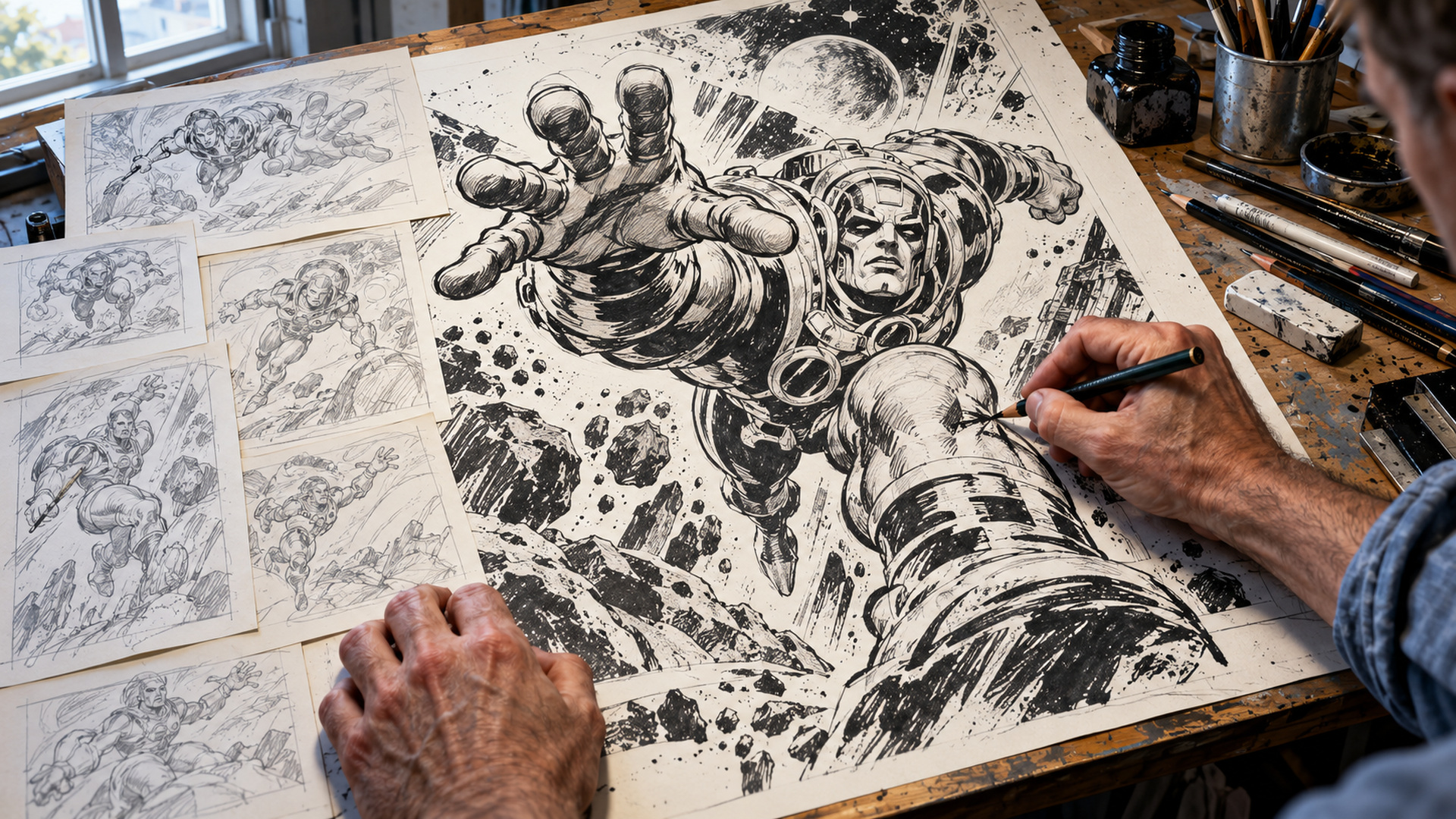
His Spider-Man imagery is often associated with exaggerated poses, densely rendered webbing, and a strong emphasis on silhouette. Those traits make an immediately visible statement about what a familiar superhero body can do on a page. The character can appear more flexible, more graphic, and less governed by an ordinary standing figure. That effect is a matter of visual interpretation, not evidence that earlier artists had exhausted the character’s possibilities.
Recognizability becomes especially powerful in serial publication. A reader can notice an artist’s approach before reading a credit and may begin following that artist across assignments. This changes the relationship between a company-owned property and the person drawing it. The character brings an established audience, while a distinctive contributor supplies an additional reason for that audience to pay attention.
Detail works when it organizes attention
Dense rendering is easy to describe as simply adding more lines. The more useful question is what those lines do. Webbing can create a surrounding rhythm, costume folds can direct the eye, and a large shape can anchor an otherwise complicated image. In an effective composition, detail supports hierarchy: readers still need to identify the figure, understand the action, and know which visual information deserves attention first.
The same density can become a limitation if every area competes equally. That is why close reading should consider complete pages as well as celebrated covers. A cover can reward a prolonged look at a single arrangement, while interior storytelling must move through changing moments. Admiring a style becomes more precise when it includes asking how the style handles those different obligations.
Creator popularity changes the available choices
McFarlane’s prominence belongs to a period when highly visible superhero artists could attract audiences in their own names. A recognizable signature style could become part of a book’s commercial appeal. Readers following the creator might be willing to investigate an unfamiliar property, which created possibilities beyond an established publisher’s characters. That possibility, however, was an opportunity rather than a guarantee that every new project would find lasting support.
An artist leaving a famous character behind exchanges one set of advantages for another set of responsibilities. A new creation may offer room to define the imagery and story, but it lacks the automatic familiarity of a long-established franchise. Promotion, continued production, and a clear reason for readers to return all become part of the challenge. The change is therefore creative and institutional at the same time.
This is a helpful context for Image’s beginnings. It makes the launch more than a dramatic announcement or a story about rejecting an employer. The founders were attempting to convert individual creative visibility into an enduring publishing arrangement. Evaluating that move requires attention to the structures they built as well as to the striking first issues they produced.
Image provides a different publishing framework
Image Comics was founded in 1992 by a group of artists that included McFarlane. Its official FAQ explains the publisher’s creator-owned orientation and distinguishes Image Central from autonomous associated companies. The Image name does not automatically mean that a central corporation owns all the characters it publishes. The publishing relationship and the ownership of a particular property need to be identified separately, with the relevant project rather than a broad slogan as the unit of discussion.
Spawn offers a striking invitation into unfamiliar territory
Spawn launched in 1992 as McFarlane’s signature creation at Image. The publisher’s first-issue record anchors that beginning, while its series page identifies collections of the early material. The essential introductory point is the move from interpreting a familiar hero to developing a property around a distinct visual identity and dramatic premise. Readers who arrived because of the artist still needed a reason to remain for the creation.
Al Simmons’s return into a changed world gives the premise more than a costume to display. Dislocation, memory, anger, and the distance between former life and present condition can support continuing conflict. The supernatural environment enlarges those pressures rather than replacing them. A strong introductory reading pays attention to what the central figure wants and cannot recover, alongside the images that make him immediately identifiable.
The cape is part of the storytelling space
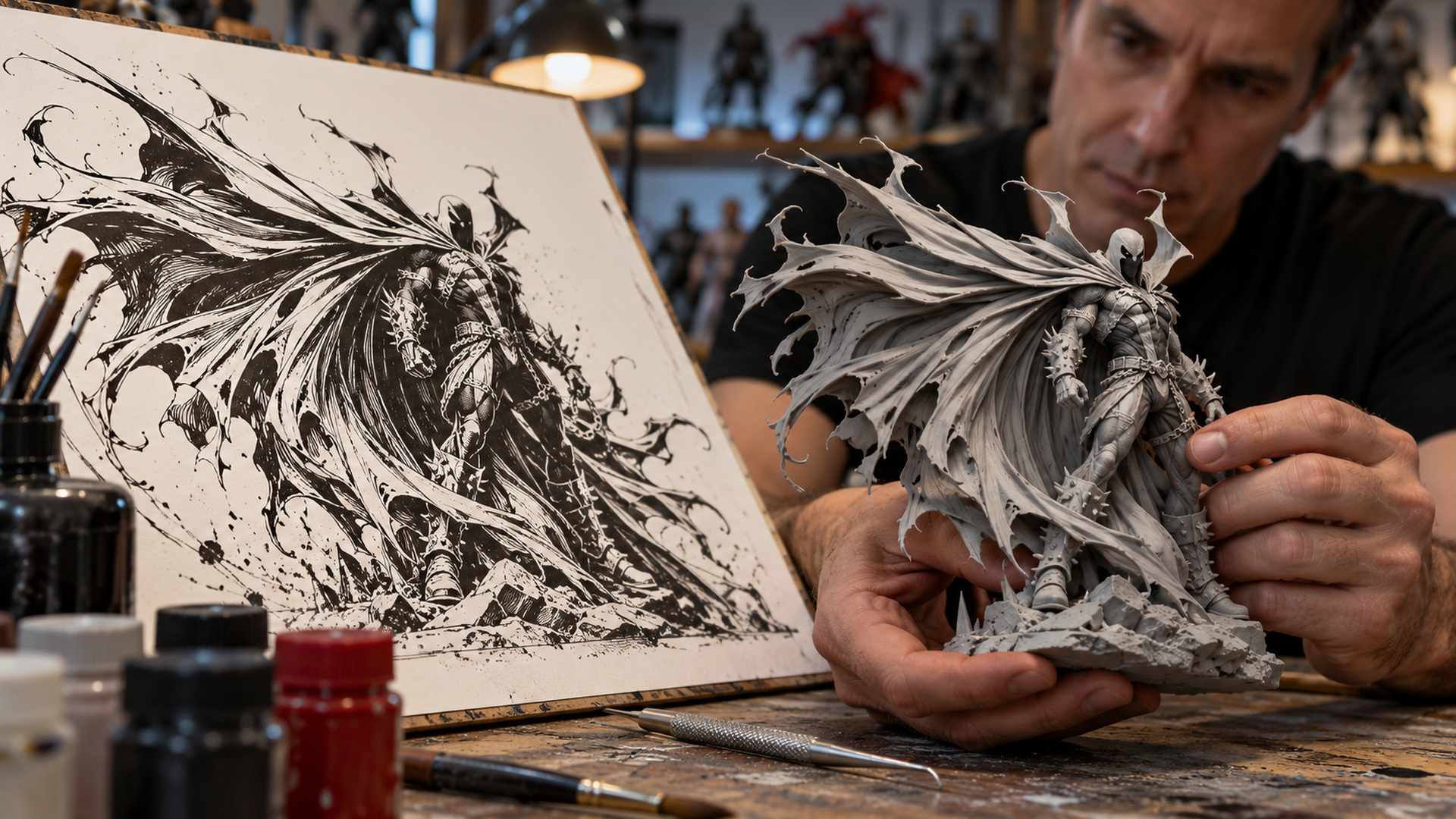
Spawn’s cape is useful to study because it changes the shape of a scene. It can surround a body, create a large area of contrast, or make a figure appear to occupy more space than ordinary anatomy would permit. In a static image, those decisions establish presence. Within a sequence, the relationship between the cape and surrounding objects can also influence how movement and proximity are understood.
Chains, shadow, costume markings, and exaggerated fabric create another level of visual identity. The important distinction is between a recognizable inventory of motifs and a composition that uses them effectively. Merely including the motifs does not ensure a readable page. Their arrangement has to serve emphasis, atmosphere, and the reader’s route through the image.
These observations connect McFarlane’s earlier superhero interpretation to the later property without treating them as identical projects. A strong silhouette and an appetite for dramatic rendering can persist across settings. The fictional stakes and production arrangements can change substantially. Style supplies continuity in a career, while the different works reveal what that style is asked to accomplish.
An ongoing property requires more than a spectacular launch
A launch makes a promise; continued publication must repeatedly fulfill or revise it. Spawn’s longevity therefore matters as a different achievement from the attention surrounding its debut. Image’s 2019 announcement around issue #301 marks one historical milestone in that continuing run. Such a milestone should be described with its date rather than converted into an unsupported claim about every present-day record.
Longevity also means a larger community of contributors. Other artists, writers, and production workers become part of how readers encounter a property over time. McFarlane’s continuing association remains central, but the name on the founding story should not make later collaborators invisible. A continuing series is both an identifiable creation and a changing record of work by particular people.
Collectibles translate design into different physical rules
McFarlane founded his toy business in 1994, a development identified in his Image creator biography. The move connects naturally to a career attentive to striking silhouettes and visual detail. Nevertheless, a manufactured figure is not simply a drawing rendered solid. It has to exist as an object viewed from multiple angles, with choices about balance, materials, scale, and the relationship between sculpted form and paint.
A dramatic pose that reads perfectly from one illustrated viewpoint can create a different set of problems in three dimensions. A sculptor has to decide how volumes connect beyond the visible outline; production specialists must consider how the object will be made. Paint then supplies separations and emphasis that ink or color previously created on a flat page. The translation involves interpretation at every stage.
That collaborative process is part of the achievement rather than an inconvenient qualification. Expanding into another medium means bringing together expertise that the original image did not require. The business can carry a founder’s aesthetic priorities while depending on many other people’s decisions. Understanding that distinction makes the phrase “Spawn empire” more concrete: it describes coordinated creative and commercial activity, not a magically self-producing extension of one drawing board.
Ownership and collaboration answer different questions
Creator ownership is significant because it concerns a person’s relationship to the work and the choices available around it. It should not be used as a synonym for solitary authorship or as proof that every contributor has identical rights. Those matters depend on specific arrangements and histories. An introductory profile can explain the importance of the distinction without pretending to give a legal account of every project or dispute associated with a long career.
How to trace the career without following only the hype
Begin by comparing a complete Spider-Man sequence with an early Spawn sequence. Identify what feels continuous in the drawing and what changes in the dramatic situation. Then look at a collectible as an interpretation of design rather than a replacement for the page. These comparisons make the movement between properties and media observable, instead of reducing the career to a list of successful products.
It is equally useful to check which role McFarlane held in a specific issue or project. Writing, penciling, inking, cover art, ownership, publishing, and executive oversight are different contributions. A familiar name may appear in several capacities at once, but that does not make the capacities interchangeable. Following the credits helps turn a celebrity-centered story into a history of actual creative work.
McFarlane’s lasting significance comes from the connection between a recognizable visual proposal and the institutions that allowed it to travel. Spider-Man demonstrated the force of an interpretation; Image and Spawn expanded the question of what a popular creator could build; collectibles brought designs into another material form. The thread is not simply ambition rewarded. It is the recurring effort to make a distinctive idea readable, recognizable, and sustainable across different kinds of production.
What the material version teaches about the original
Looking at a figure can send a reader back to the comic with a sharper awareness of what the drawing selected. The printed image controlled the viewpoint and could hide inconvenient connections behind shadow or fabric. The physical interpretation has to make choices about those hidden areas, which reveals how much of the original impression depended on suggestion. This does not make one medium more complete than the other. It shows that each produces a convincing experience through different constraints, and that a strong design can invite several kinds of interpretation without becoming the same object in every form.
For a general reader, that comparison is more useful than treating every new product as another measure of a creator’s importance. A career can expand commercially while particular works vary in interest, and an individual object can reveal thoughtful decisions without defining the whole enterprise. McFarlane’s story rewards attention at both scales. The broad history explains how opportunities became institutions; the close view explains why a pose, a fold, or a distinctive outline continued to attract attention. Together they make the journey from superhero page to collectible tangible, with the creative labor still visible along the way.