The story is already moving before the words arrive
A Jack Kirby page can feel as though it has more momentum than the paper should contain. Bodies surge toward the reader, machines seem too large for their surroundings, and a gesture can turn a conversation into a confrontation. Those effects are easy to celebrate as powerful drawing, but they also reveal something more fundamental: Kirby was constructing stories through images. His legacy includes famous characters and extraordinary designs, yet a catalog of creations cannot fully explain his importance. Across partnerships, genres, and publishers, he made decisions about what happens, which moment we see, and how one image changes the meaning of the next. Following that work gives the familiar title “King of Comics” a concrete basis. It also restores the writer, planner, and persistent inventor inside a reputation sometimes reduced to a distinctive way of drawing fists.
A: His visual plotting and sequence construction helped determine what happened in the stories.
A: No. Their sustained partnership produced significant work across several genres.
A: No. Variation between restrained and expansive moments contributes to the effect.
A: No. Their design can communicate scale, danger, or unfamiliar possibility.
A: It developed across several related titles.
A: Yes. Its action also supports concerns about freedom, identity, and chosen relationships.
A: No. His later career included major new DC and independent projects.
A: The surrounding rhythm and sequence that help give those images force.
A: No. Inking remains a distinct contribution to the published page.
A: Study how his sequences organize information, movement, and dramatic pressure.
A working storyteller before the superhero monuments
Kirby’s early career involved several forms of visual storytelling rather than a straight path toward one superhero publisher. The Jack Kirby Museum biography documents work in animation and newspaper material before the partnerships for which he became best known. That range helps explain a basic feature of his practice: an image had to communicate. Movement, expression, and staging were working tools for delivering a readable experience under practical commercial conditions.
His reputation can make every early assignment appear to anticipate later masterpieces. It is more useful to recognize experimentation, repetition, and the need to earn a living. A creator working through different formats learns what survives changes in scale, deadlines, and subject matter. The later cosmic page did not emerge from a vacuum; it belonged to a practiced ability to convert situations into sequences readers could follow.
Joe Simon and the power of a producing partnership
Kirby’s partnership with Joe Simon is essential to an account of his career. Captain America belongs to their shared creation, not to a later company spokesperson or to a version of history that remembers only one partner. The collaboration also extended across other features and genres. Recognizing that breadth prevents a famous superhero from making the rest of a substantial working relationship disappear.
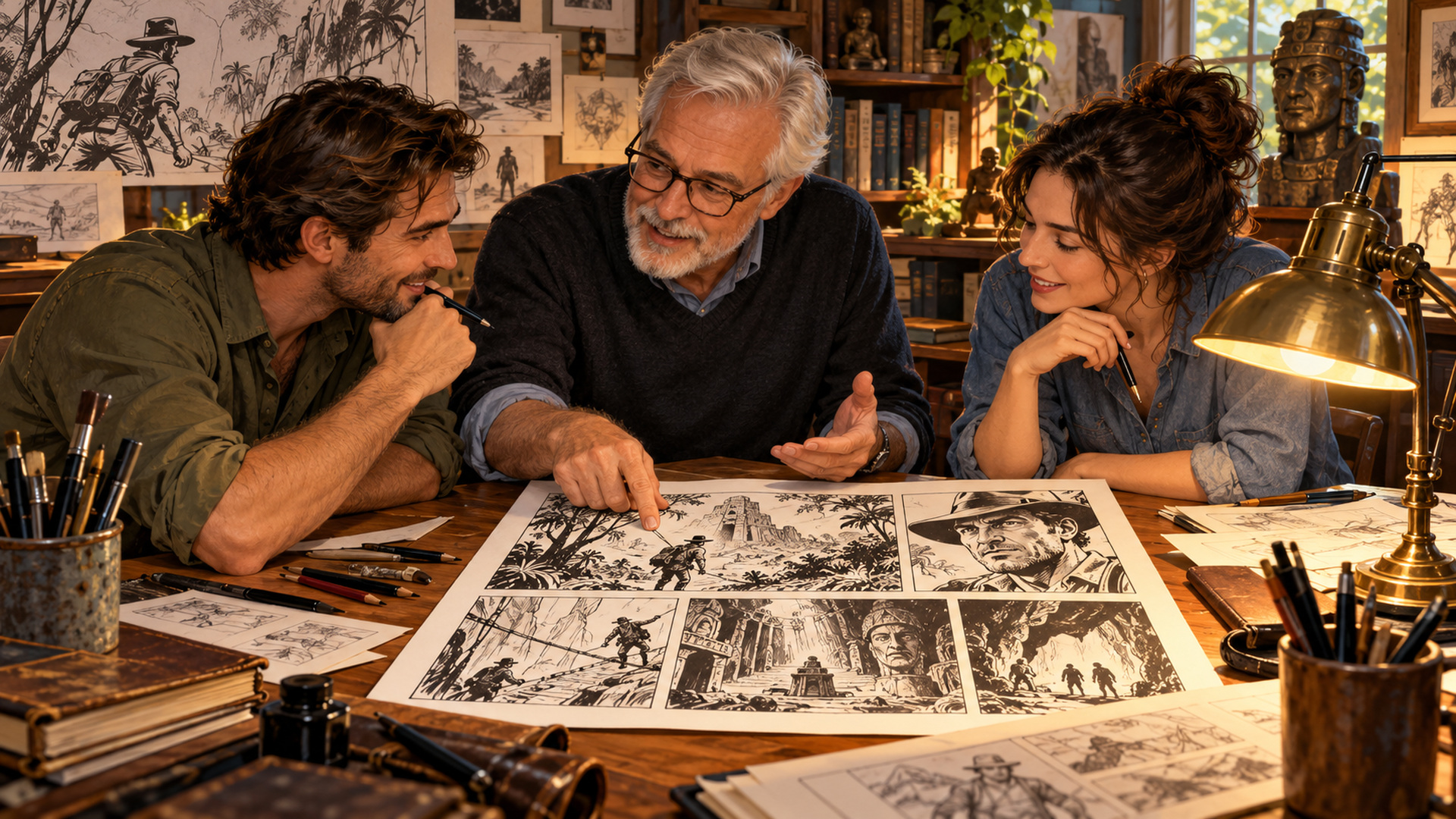
A productive partnership can be more than an exchange between a finished script and finished pictures. It can involve developing a property, organizing assignments, responding to a market, and building a way to produce work together. Those activities matter even when a reader’s attention falls naturally on the page. They remind us that creative history includes the arrangements that make sustained invention possible.
Simon and Kirby’s romance comics are especially useful for widening the familiar image of Kirby as only a superhero artist. Human relationships and emotional turns require readable behavior, not merely impressive impact. Their place in his career invites a different kind of attention to the drawings. The same capacity to stage a decision or emphasize a reaction can serve an intimate exchange as well as a spectacular battle.
At Marvel, page construction becomes central to authorship
Kirby’s collaboration with Stan Lee helped establish much of Marvel’s early superhero identity, including the Fantastic Four. Accounts of the working process describe artists developing visual sequences before final dialogue was added, with the amount of advance plotting varying by project and collaborator. Kirby’s role therefore cannot be accurately described as making illustrations for a completely settled verbal story. Deciding what the characters do across a page is part of making the story itself.
This distinction does not require dismissing dialogue, editing, or the contributions of other workers. It requires describing the different layers with enough precision that one layer does not erase another. The completed issue is where they meet. An analysis of its authorship should attend to the narrative information supplied by sequence, staging, and design alongside the information supplied by captions and speech.
A body position can carry the dramatic argument
Consider how a figure leaning forward differs from one whose weight is held back. Even without dialogue, those positions can suggest commitment, resistance, hesitation, or imbalance. Kirby’s exaggerated figures make such relationships forceful and legible. The effect is not simply that a punch looks harder; physical arrangement tells the reader how strongly a character occupies a situation and what kind of response the scene demands.
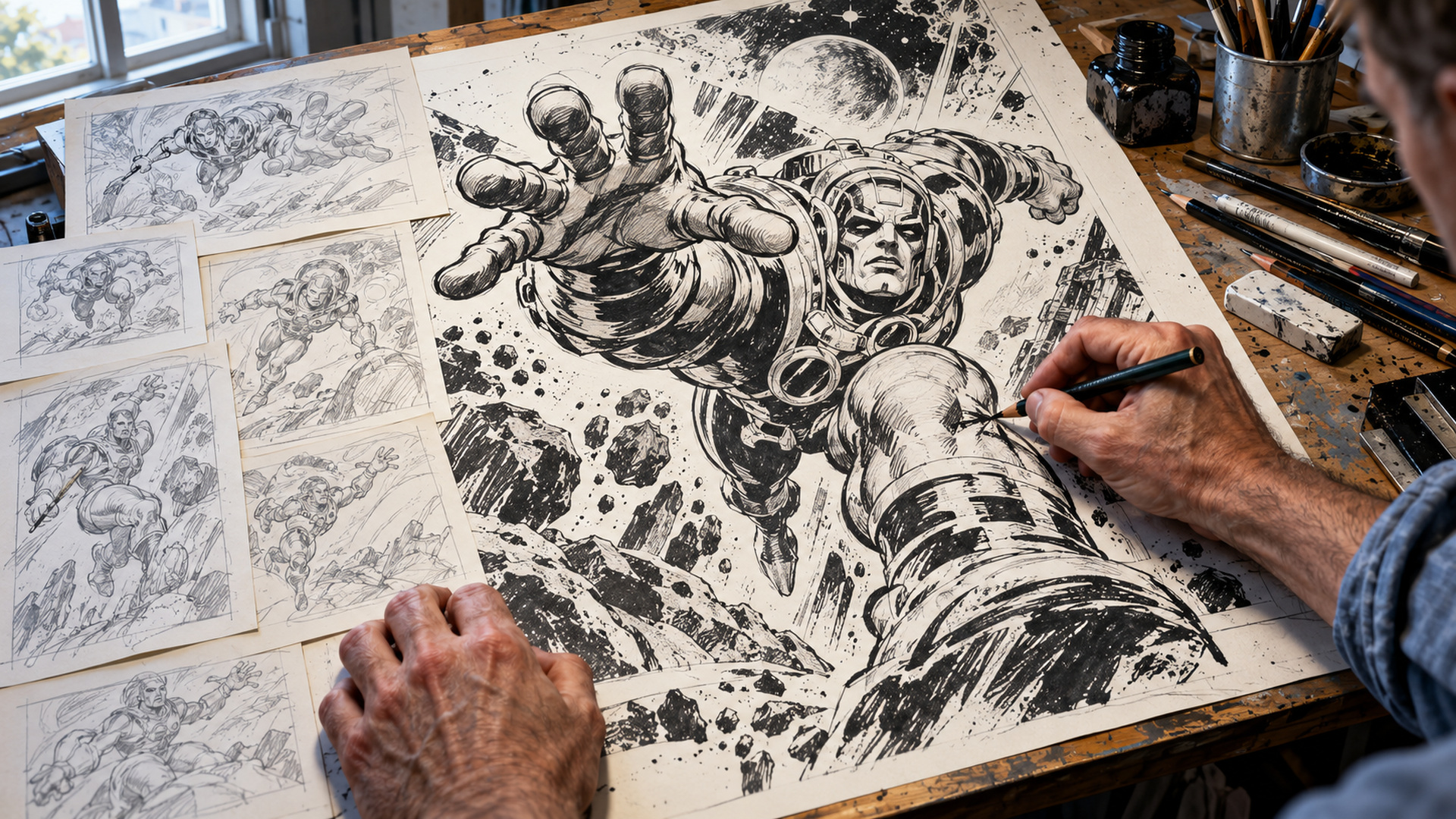
Foreshortening can also establish a relationship with the audience. A hand or body thrust toward the foreground makes space seem to compress, giving the impression that the action is arriving rather than remaining safely distant. The reader is asked to negotiate a visual force. When used within an intelligible sequence, that force can turn a familiar event into a distinct experience of urgency.
The strongest way to understand this is to compare adjacent panels rather than isolating the most famous image. An expansive gesture may gain power because the preceding panel restrained movement. A reaction can redirect attention after a moment of impact. Kirby’s visual intensity becomes easier to explain when it is read as organized rhythm, with variation doing as much work as spectacle.
Machines and worlds that imply more than they explain
Kirby’s elaborate machinery often suggests systems too extensive to be exhausted by a single explanation. Dense forms, conduits, and unexpected scales make an object feel as though it belongs to a larger technological environment. The reader does not need an engineering diagram to understand its narrative purpose. Design can establish possibility, danger, or an encounter with forces beyond a character’s ordinary frame of reference.
The Fourth World gives invention an interconnected stage
At DC in the early 1970s, Kirby developed the Fourth World across titles including New Gods, Mister Miracle, The Forever People, and Superman’s Pal, Jimmy Olsen. DC’s discussion of the project describes a new mythology built around New Genesis and Apokolips. The important point for a beginning reader is that the titles form related approaches to a larger imaginative conflict, rather than one book containing all of it.
That structure offers a useful way to think about world-building. A world can acquire depth because different stories reveal different pressures within it, not because an opening chapter explains every institution. An escape artist’s immediate predicament and a confrontation involving vast political power can belong to the same larger dramatic landscape. Their difference helps the landscape feel inhabited rather than merely cataloged.
The Fourth World also places questions about freedom, power, belonging, and coercion inside energetic popular storytelling. Its scale does not require it to abandon human stakes. A character facing domination still has to act, resist, or imagine another relationship. The cosmic setting magnifies those choices, allowing the drawings to make an abstract pressure physically confrontable.
Mister Miracle makes escape more than a stunt
Mister Miracle provides a particularly accessible illustration of how a central idea can operate on several levels. An escape sequence offers an immediate visual problem: understand the trap, perceive the danger, and follow the attempt to survive it. The same premise can also invite attention to the forces a person wants to leave behind. The spectacular action and the emotional meaning do not need to compete for space.
Big Barda’s presence further complicates the assumption that cosmic comics consist only of distant symbolic figures. Relationships, loyalties, and the possibility of a chosen life give the scale something to bear upon. DC’s collection listing identifies Kirby’s writing and art alongside other production credits, making it a practical route into the work. As always, the precise edition tells readers which material and contributors they will encounter.
The career remains larger than the best-known universes
Kirby’s output beyond his most celebrated Marvel work includes DC projects such as Kamandi, The Demon, and OMAC. DC’s creator catalog makes that range visible. Each title gives a reader another setting in which to test assumptions about his style. An inventive artist should not have to remain inside one familiar fictional environment to be recognizable as himself.
Later projects associated with the independent comics environment, including Captain Victory and Silver Star, extend that picture further. They matter because a career is not finished simply when its most profitable characters have been created. Continuing to propose unfamiliar worlds is itself part of Kirby’s legacy. It reveals an imagination that kept working beyond the milestones most convenient for retrospective summaries.
The publishing setting also affects how a project should be discussed. Creative control, production arrangements, and the reception of a new title can differ from one company or period to another. A short profile cannot settle every business dispute, and it should not invent certainty where the evidence is complicated. It can still make the essential distinction between the work a person created and the commercial structures through which that work circulated.
Influence is more than reproducing the surface
A later artist can imitate broad hands, energetic poses, or elaborate technology without reproducing the storytelling that gives those features purpose. Kirby’s influence becomes more meaningful when it includes attention to relationships between images. What does a page make clear? When does it withhold a reaction? How does its largest panel change the surrounding rhythm? These questions turn admiration into an investigation of choices rather than a collection of recognizable decorative habits.
Reading the King as a maker of sequences
Choose a complete scene and read it first at an ordinary pace. Then return and identify where your eye moves, which panel establishes the space, and which moment changes the pressure. Notice whether the drawing already tells you something that the dialogue later names. This exercise does not require separating words and pictures into opposing teams; it makes their relationship easier to observe.
Credits remain important throughout the exercise. Different inkers and other collaborators affect the finished appearance of Kirby’s work, and different writing arrangements affect how the page came into being. The point of recognizing his authorship is not to make everyone else disappear. It is to understand how his substantial contribution interacts with the labor that reaches the reader alongside it.
Marvel’s reflection on his continuing legacy explicitly recognizes the writer as well as the artist. That is an appropriate place to end a first encounter and begin a deeper one. Kirby’s extraordinary images do not merely decorate stories that happen elsewhere. They are among the places where the stories are invented, made legible, and given the energy that keeps readers returning to the page.
The quiet panel belongs in the legacy too
A reputation for explosive action can make readers overlook the explanatory work done by quieter images. A character listening, pausing at a threshold, or recognizing something can establish the stakes that make later movement meaningful. These moments do not have to look subdued in every detail to perform that function. What matters is their place within the sequence: they give the reader a situation to understand before the drawing transforms it. Studying them helps explain why a forceful style can support sustained narrative rather than only repeated moments of impact.
This attention also makes comparisons with later artists more useful. Instead of asking whether someone draws a sufficiently powerful fist, ask how that person prepares a change in the scene and makes its consequence visible. Influence can operate through the management of information, the confidence to invent an environment, or the willingness to let a pose carry an idea. Those habits are harder to recognize than a borrowed motif, but they offer a deeper account of why Kirby continues to matter. His legacy survives in the ways creators think through pages, including pages whose surfaces look little like his own.