The familiar face behind a collaborative medium
For many readers, Stan Lee became the person who seemed to embody Marvel Comics: an energetic voice, a recognizable public presence, and eventually a familiar figure even to audiences who knew the characters mainly through adaptations. That visibility is an important part of his career, but it can also make the history harder to see. The comics that built his reputation were collaborative objects, produced through the contributions of artists, writers, inkers, colorists, letterers, editors, and others whose names were not always equally prominent. Lee’s legacy becomes more substantial, rather than less interesting, when those relationships remain visible. His dialogue, editorial choices, promotional style, and participation in character creation helped give Marvel a recognizable identity. Understanding those achievements requires looking past the celebrity image to the changing work, production practices, and partnerships through which they took shape.
A: Yes. His career began decades before that 1961 debut.
A: No. It accurately identifies creation shared with other contributors.
A: No. The working arrangement varied by creator and period.
A: Yes. Selecting events, pacing them, and staging character behavior are narrative decisions.
A: They show how Lee addressed readers and framed the publishing line.
A: No. Visibility in an adaptation is a different kind of relationship.
A: Identify the accounts, consider supporting evidence, and avoid presenting a disputed claim as settled.
A: They help shape the finished page and should remain visible in its credits.
A: Yes. Its effectiveness and its historical simplifications can both be examined.
A: Read a complete credited issue and investigate the collaborators whose work shaped it.
A career that started before the famous superhero line
Lee entered the business as a teenager in 1939, long before the cluster of 1960s titles most associated with him. Marvel’s creator reading guide points to an early prose contribution in Captain America Comics #3, published in 1941. This chronology prevents a misleading impression that he arrived at a fully formed Marvel Universe and simply began introducing its best-known heroes. His career developed within an older publishing operation that changed names, genres, and circumstances.
That long apprenticeship matters because editorial experience involves more than originating new characters. Working across material and deadlines can teach someone how to recognize a usable premise, coordinate contributors, or make an issue readable within commercial limits. Those capacities do not prove authorship of every idea produced under an editor’s supervision. They help explain why editing deserves its own place in an account of creative work.
It is also useful to resist reading the early years entirely as preparation for a guaranteed triumph. A career looks more coherent after its successes are known than it would have looked to the person living through uncertain assignments. Lee’s eventual public identity can obscure that uncertainty. Keeping the earlier publishing environment in view restores a sense of contingency to the later breakthrough.
Character creation happened through partnerships
The early Marvel superhero line emerged through major collaborations. Lee and Jack Kirby co-created the Fantastic Four, whose first issue appeared in 1961; Lee and Steve Ditko co-created Spider-Man, introduced in 1962. Those credits identify partnerships, not a complete transcript of every conversation or production decision. Different characters and stories involve different evidence, and a responsible account should avoid assigning an entire universe to any one participant.
Marvel’s Silver Age overview also names collaborators including John Romita Sr. and Bill Everett. Their presence helps widen the picture beyond a single celebrated duo. A publishing line develops through many combinations of people over time. The distinctive qualities of a particular book may depend on a partnership that differs substantially from the one shaping another title on the same month’s rack.
Dialogue turns an event into a social encounter
One practical way to study Lee’s contribution is to look at what dialogue does on an already organized page. Two characters may be confronting the same danger while speaking from very different emotional positions. A confident boast, an embarrassed deflection, or a complaint can make the exchange feel social rather than merely informational. The words give readers something to interpret about relationships as well as the immediate sequence of events.
In a superhero serial, that social information can matter beyond the scene containing it. Friction within a team invites readers to wonder how its members will continue working together. A private insecurity can make an apparently victorious ending feel unresolved. Such effects are among the reasons early Marvel stories could encourage attachment to ongoing personal lives rather than to isolated displays of ability.
These are reading observations, not a claim that Lee invented emotional characterization or that every line he wrote succeeds equally. Earlier comics also contained vulnerability, humor, and conflict. The useful question is how a particular combination of speech and pictures works in a particular issue. Close attention gives Lee’s verbal contribution a more precise description than the broad claim that he made all superheroes human.
The Marvel Method changes what writing can mean
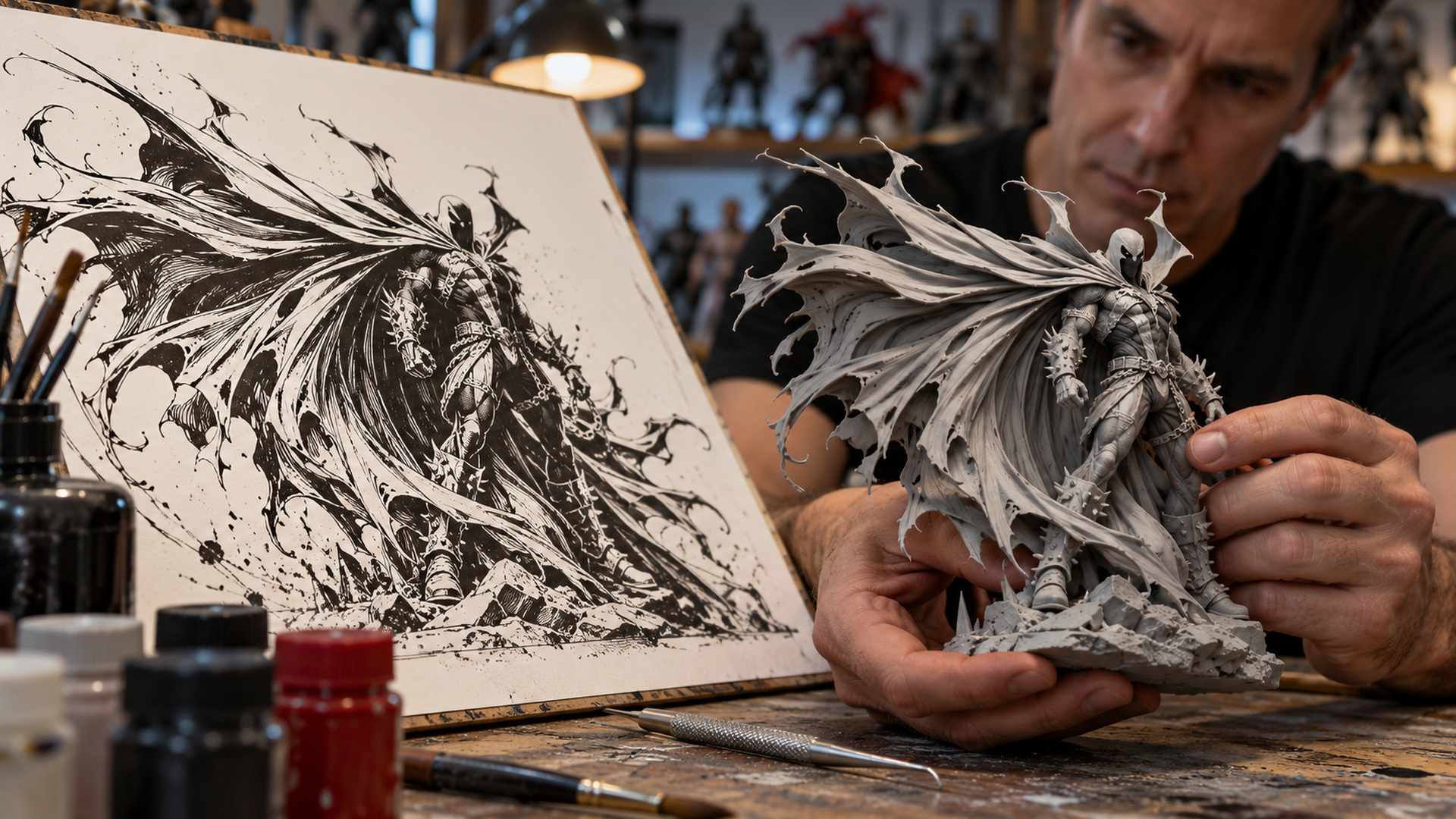
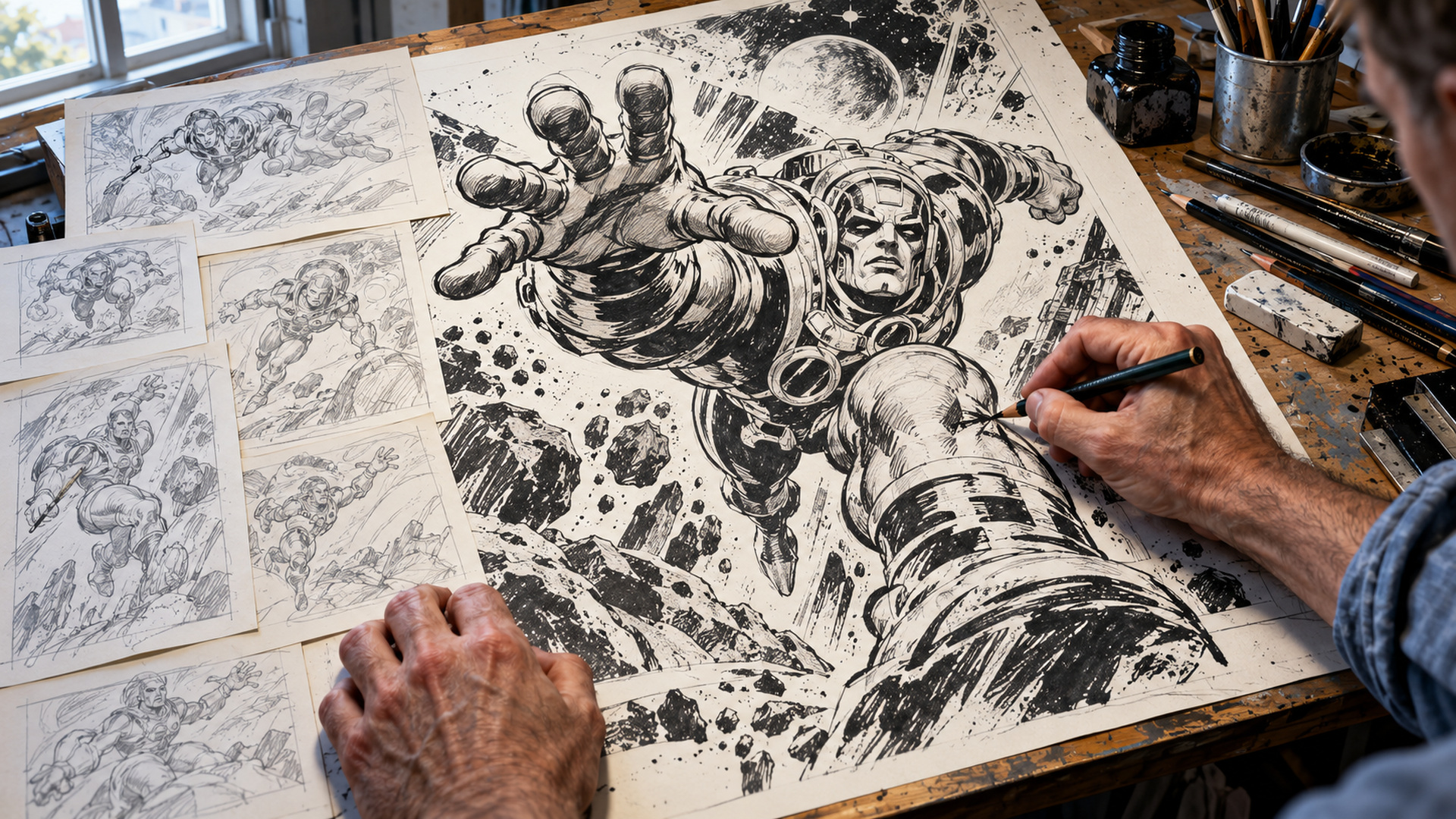
In the production approach commonly called the Marvel Method, an artist could work from a plot or discussion and develop the visual sequence before dialogue and captions were finalized. The exact process varied by collaborator and period. That variation is crucial: a label for a workflow does not tell you how much plotting any participant supplied on every occasion. Visual construction can include decisions about events, pacing, characterization, and emphasis that belong to storytelling rather than to decoration alone.
Pictures and words can pull in different directions
A finished page may combine an artist’s dramatic staging with a script that adds a different emphasis. Sometimes those layers reinforce one another; sometimes their relationship is more complicated. The visible expression of a character, the action between panels, and the chosen dialogue can suggest slightly different readings. Examining that relationship respects both contributions and makes a comic more interesting than a contest over whether only words or only pictures count.
It also explains why reconstructing the process requires evidence beyond the printed credit line. Surviving art, marginal annotations, scripts, correspondence, and accounts by participants can illuminate a particular case. They do not always resolve every disagreement. An introductory profile can acknowledge those limits without pretending that uncertainty makes all contributions unknowable or equally well documented.
Editing gives a line a recognizable conversation
Lee’s editorial role helped connect different comics through presentation and address. Readers encountered more than a sequence of disconnected fictional adventures; they encountered a publisher speaking as though it knew them and expected them to return. That conversational effect can be understood as a form of framing. It tells an audience how to relate to the stories and to the people whose names appear around them.
Editorial framing does not manufacture reader loyalty by itself. The actual comics still need to reward attention, and different readers respond to different tones. Yet a recurring voice can make a large line feel more navigable and personal. It can encourage the impression that discovering another title means entering a neighboring room in the same lively house.
The same intimacy has a historical cost if it makes the public spokesperson seem responsible for every room’s contents. Publicity can concentrate attention on a person whose job includes representing a collective effort. A careful profile therefore distinguishes the effectiveness of Lee’s audience relationship from the full distribution of creative labor. Both are real parts of the story, but they answer different questions.
Promotion becomes part of the reading experience
A superhero comic contains several invitations besides the central story: continue this plot, try another title, recognize a creator, join a community of readers. Lee’s public style made those invitations unusually conspicuous. Playful language and a sense of shared enthusiasm could make buying a comic feel like participation in something ongoing. That experience belonged partly to the pages surrounding the adventure, not only to the panels inside it.
Promotion should still be interpreted as promotion. An entertaining account of an idea’s origin may simplify a long and disputed development process. A memorable nickname can help audiences remember an artist while also placing that artist within an editorial performance. Readers can enjoy the style and ask historical questions about it at the same time, without assuming that enthusiasm supplies complete documentation.
Celebrity expands the story and compresses it
As Lee became widely recognizable beyond comics, he served as an accessible connection between audiences and an increasingly familiar group of fictional characters. Public appearances and screen cameos gave that connection a human face. For someone arriving through a film, his name might be the first creator name they learned. That entry point can be valuable if it leads toward the books and the larger community of people who made them.
The compression happens when recognition becomes a substitute for attribution. A cameo does not identify who designed a costume, developed a visual sequence, or added a defining feature years later. Nor does a public association with Marvel establish creative involvement in every subsequent adaptation. The simplest corrective is specific credit: name the character or issue, identify the relevant people, and describe the actual kind of work under discussion.
Celebrity can also rearrange the apparent order of importance. A person seen frequently in interviews may feel closer to an audience than an artist whose influence is embedded in thousands of drawings. Historical visibility and creative significance do not always rise together. Lee’s profile is most illuminating when it makes that distinction available rather than asking readers to ignore it.
Disputed credit deserves care rather than a slogan
Questions about Lee’s collaborations have generated passionate disagreement. The responsible response is neither to erase his documented work nor to treat his fame as a verdict settling everyone else’s contribution. Creation, scripting, plotting, editing, legal ownership, and later publicity are related but distinct categories. Claims become easier to assess when they identify which category is meant and which evidence supports it.
Readers should also distinguish a general history from the reconstruction of an individual story. A workflow can describe an institutional tendency while a surviving page reveals a more specific division of labor. Accounts from participants may differ in emphasis or memory. Acknowledging a dispute is not the same as resolving it, and an introductory article should not pretend that a confident tone can replace the necessary evidence.
How to read Lee’s work with the collaborators in view
Begin with a complete issue rather than a collection of famous quotations. Notice where the page makes you pause, what information arrives through the drawing, and what the dialogue adds to your sense of the characters. Then read the credits and identify the contribution you are trying to describe. This approach makes praise more concrete: instead of crediting a brand spokesperson with everything you enjoyed, you can explain how several kinds of work combined to produce the effect.
A legacy measured in habits of attention
Lee helped make the people and personality surrounding a comic visible to readers. That is one reason his influence extends beyond the specific fictional characters associated with him. He demonstrated how an editor and writer could become part of the audience’s ongoing relationship with a publisher. The achievement is clearest when understood alongside the stories, art, production work, and reader enthusiasm that made the performance meaningful.
His legacy also leaves a useful challenge for anyone discussing comics: learn more names, not fewer. Admiration for Lee can become a route into Kirby, Ditko, Romita, and the many other contributors whose work gives the history depth. A recognizable face can open the door without occupying every room. Seen that way, the life behind Marvel’s public voice leads toward a collaborative medium whose richness exceeds any single biography.
Keeping the printed voice in its historical setting
Modern readers encounter older dialogue with different expectations about pacing, repetition, and exposition. A dense caption may feel excessive in a contemporary collection while serving readers who originally met the story a month after the previous issue. That context does not require anyone to enjoy every stylistic choice. It does encourage a more exact judgment: ask what the language is trying to accomplish for its audience, then assess how effectively it does so. Historical sympathy and critical attention can occupy the same reading experience.