
How Parallel Timelines Became a Storytelling Tool
Parallel timelines changed comic book storytelling because they gave creators a way to question the main road without abandoning it. A branch timeline can test a hero's values, expose the architecture of continuity, widen a universe, or let a familiar myth argue with itself. The most important timeline stories are not merely alternate costumes and dramatic reveals. They changed how comics handle consequence, reader expectation, character identity, and the strange relationship between permanent mythology and endlessly renewable serial adventure.
A: They made continuity, consequence, and character identity flexible tools for storytelling.
A: No. They can drive quiet character studies as well as universe-sized crossovers.
A: They let readers feel the difference between histories without long explanation.
A: Yes, because they can change reader understanding and character memory.
A: They test which parts of a character are essential and which depend on circumstance.
A: Not when they illuminate the main world and serve a clear thematic purpose.
A: They provide scale while keeping the stakes tied to recognizable people.
A: Yes, especially when the altered premise is clear and emotionally direct.
A: Keeping chronology readable while making the alternate world feel genuinely different.
A: They let comics renew familiar myths without discarding their emotional history.
From Novelty Premise to Narrative Engine
Early alternate-history ideas often carried the excitement of novelty: here is the hero in a different era, here is the villain victorious, here is the future gone wrong. Over time, comics learned that the format could do more. A parallel timeline could become a narrative engine, driving conflict from the pressure between two possible versions of reality.
That shift mattered. Once timelines became engines, they changed how stories were built. Writers could structure entire arcs around comparison, memory, restoration, and moral consequence. Artists could use visual repetition to make the comparison immediate. Readers were invited to think about continuity as something active rather than merely accumulated.
Redefining Consequence Without Ending the Series
Long-running superhero comics face a difficult balance. Readers want meaningful consequences, but the series also needs to continue. Parallel timelines offered a solution that could be more sophisticated than a simple reset. They allowed creators to show extreme outcomes, follow them seriously, and then return to the main world with new emotional knowledge.
This did not make the consequences fake when the story was handled well. The branch became a demonstration, a warning, or a memory. It let readers feel what would happen if the rules changed too far. Even if the central timeline survived, the audience understood its stakes more sharply afterward.
That storytelling move redefined the relationship between permanence and possibility. Comics did not have to choose only one. They could make impermanence meaningful.
Making Continuity Visible
Continuity can be invisible when it works. Readers accept that a city has certain heroes, a team has certain bonds, and a symbol carries certain public meaning. Parallel timelines make those assumptions visible by changing them. When the same city fears the hero, when the team forms around a different wound, or when the symbol belongs to a government instead of a person, the hidden structure appears.
That is a major storytelling advantage. Instead of explaining why a relationship matters, a timeline can remove or distort it and let the absence speak. Instead of telling readers that an origin event shaped a lifetime, a branch can alter the origin and show a different lifetime unfold. Continuity becomes dramatic material, not background inventory.
Letting Icons Argue With Themselves
Comic book icons are designed to endure, but endurance can make them seem fixed. Parallel timelines loosen that fixedness. They allow one version of a character to confront another version's values, failures, compromises, or dreams. Even when the two versions never meet, the reader performs the comparison.
This changed superhero storytelling because it treated identity as an argument. Is a hero defined by powers, costume, trauma, community, discipline, compassion, or choice? A branch timeline can remove one element and ask what remains. The answer may strengthen the original character or expose a weakness the main series has avoided.
The Craft of Parallel Structure
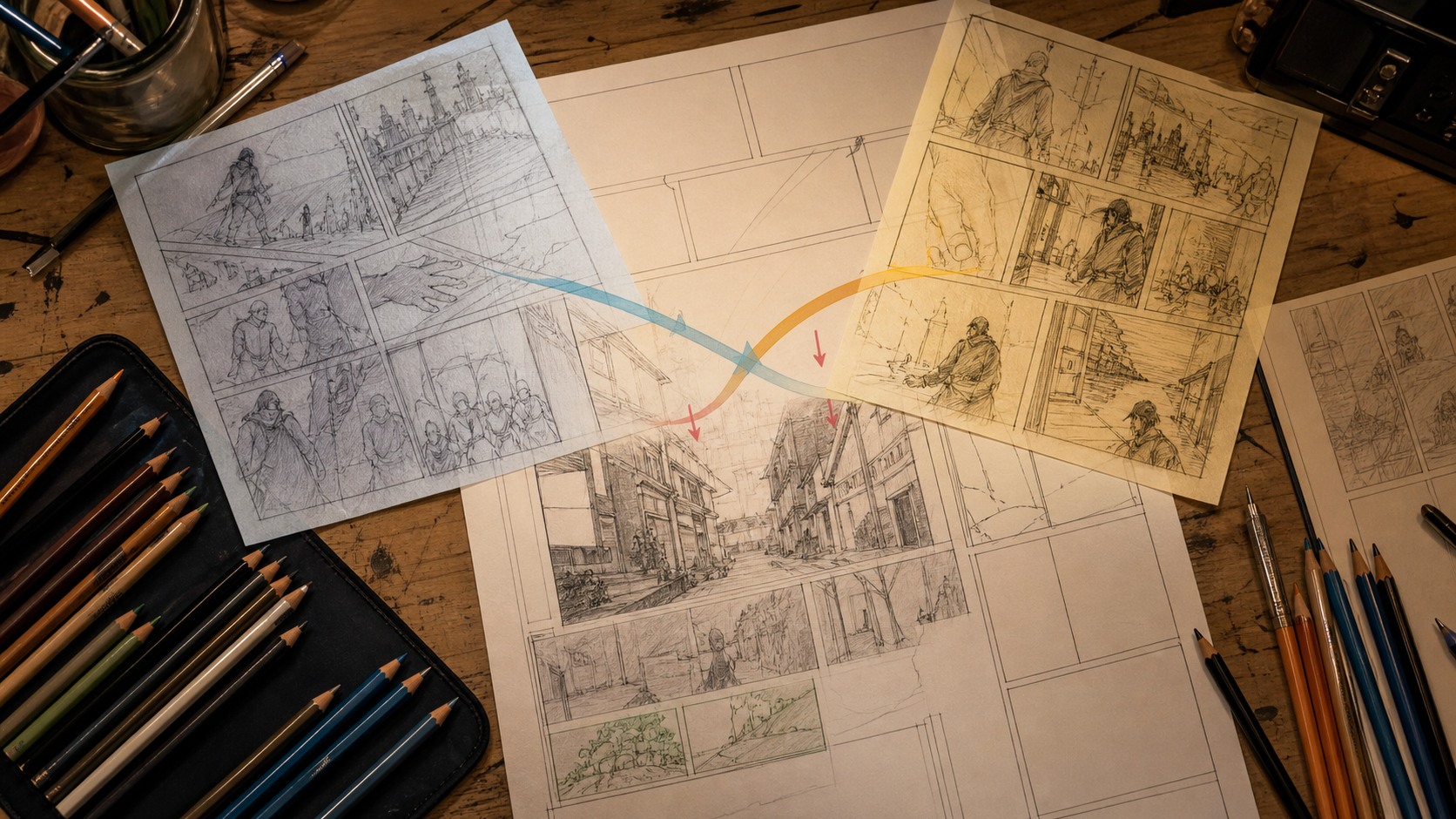
The most effective timeline stories are often carefully mirrored. A scene from the main continuity reappears with altered framing. A line of dialogue returns from a different speaker. A victory pose becomes a surrender pose. These echoes help readers understand the branch without heavy exposition, and they give the story formal elegance.
Parallel structure also creates emotional rhythm. Readers feel the distance between versions because the comic keeps placing them side by side in memory. The page does not merely report difference; it stages difference. That craft lesson has influenced many later arcs, even outside obvious multiverse stories.
When the structure is strong, readers can sense the theme in the layout. The story's form becomes part of its meaning.
Changing the Role of the Reader
Parallel timelines ask readers to become comparative thinkers. Instead of following only what happens next, the reader asks what this version reveals about another version. That changes the reading experience. A background detail becomes a clue. A changed costume becomes an argument. A missing character becomes as meaningful as a present one.
This helped comics cultivate a kind of active fandom around interpretation. Readers discuss not only plot, but implication: what the branch says about destiny, trauma, politics, family, and heroism. Timeline stories reward attention, and attentive readers reward the stories with debate.
Expanding Universes Without Diluting the Core
Parallel timelines let publishers expand a universe without forcing every idea into the main continuity. A creator can explore a radical premise, a historical branch, a future state, or a moral inversion while leaving the central series available for ongoing development. That flexibility can protect both experimentation and stability.
The best branches do not dilute the core world; they illuminate it. They show paths not taken, dangers avoided, or hopes unrealized. The main continuity becomes one choice among many, which makes its survival feel less automatic. Expansion becomes reflection rather than clutter.
Why Timeline Stories Changed Event Comics
Large event comics often use parallel timelines because the format gives them scale and personal stakes at once. A universe can fracture, but the reader still follows specific versions of specific people. The event feels massive without becoming purely abstract.
Timeline events also allow consequences to be distributed. One issue can show political change, another family loss, another future legacy, another cosmic repair. The structure supports variety while keeping a central question alive: which version of history will remain, and what will be sacrificed to keep it?
This changed how event storytelling could work. Events became not only battles, but negotiations between competing realities.
The Influence Beyond Superheroes
Parallel timeline storytelling has influenced comics beyond capes and cosmic crises. Indie, science-fiction, fantasy, horror, and literary comics also use branching histories to explore grief, identity, and social change. The technique is flexible because the underlying question is universal: how does one changed condition alter a life?
In quieter comics, the split may be intimate rather than explosive. A relationship continues instead of ending. A family moves instead of staying. A community survives one disaster but changes under another. The superhero tradition made the device visible, but the emotional grammar travels widely.
What Redefinition Really Means
A storytelling device redefines comics when it changes what readers expect stories to be able to do. Parallel timelines did that by making contradiction productive. A character could be one thing and another. A future could matter without being final. A continuity could be questioned without being discarded.
That is the lasting achievement. Parallel timelines turned instability into a creative resource. They gave comics permission to revisit, revise, challenge, and multiply their own myths while still honoring why those myths mattered. The form did not become weaker because there were more possibilities. It became more self-aware.
How Timeline Stories Changed Stakes
Before timeline stories became common, stakes often depended on whether the hero could stop the immediate threat. Parallel timelines widened that question. They asked what the world would become if the threat had already won, if the rescue had never happened, or if the victory carried a hidden cost. Stakes became historical rather than only tactical.
That change helped comics dramatize systems as well as battles. A timeline could show a society after decades of fear, a team after years without trust, or a city after its founding symbol had been corrupted. Readers were no longer watching one conflict in isolation. They were watching the long weather of consequence.
This gave creators a way to make even familiar fights feel new. The punch mattered, but so did the culture that might grow from its outcome.
Why Parallel Timelines Reward Visual Storytelling
The device is especially suited to comics because difference can be read instantly. A changed skyline, a reversed color scheme, a scarred emblem, or an empty chair can announce history before narration begins. The reader does not have to wait for exposition to sense that the world has bent.
That visual speed gives artists enormous narrative power. They can plant clues in backgrounds, mirror old covers, age a symbol, or redesign a room so that one familiar object feels wrong. Parallel timelines therefore pushed comics toward denser visual storytelling. The branch is not only described; it is embedded in the page.
The Legacy of Storytelling Instability
The lasting legacy of parallel timelines is not that every comic became more complicated. It is that comics became more comfortable admitting that their myths are constructed, revised, and argued over. That self-awareness can make stories deeper when it is used with care. Readers see the machinery and still believe in the emotion.
Modern audiences often expect heroes to have variants, possible futures, and paths not taken. That expectation comes partly from decades of timeline stories teaching readers how to enjoy instability. The challenge now is not whether comics can create another branch. The challenge is whether each branch has something honest to say.
The Balance Between Freedom and Focus
Parallel timelines gave comic creators extraordinary freedom, but the stories that redefined the medium also understood focus. A branch cannot simply be everything the main continuity is not. It needs a disciplined reason to exist. The altered world should pressure a theme, test a character, or reveal a hidden weakness in the standard mythology.
When that focus is present, freedom becomes useful rather than chaotic. A writer can change history, age characters, invert loyalties, or reshape cities because every change points toward the same question. An artist can redesign the world without making it feel arbitrary. The reader can enjoy the surprise because the story keeps proving that surprise has a purpose.
That balance is the craft lesson many later comics inherited. The timeline can open a thousand doors, but the story still has to choose the right hallway.
Why the Device Still Feels Modern
Parallel timelines still feel modern because they match how contemporary readers think about stories. Fans are used to adaptations, reboots, variants, games, films, and animated versions existing beside one another. Comics anticipated that kind of layered reading. They trained audiences to understand that a character can have multiple valid expressions without becoming meaningless.
The device also fits a culture that constantly revisits its own myths. Parallel timelines let comics ask whether old symbols still work, what they conceal, and how they might be rebuilt. That makes the format more than a continuity trick. It is a way for comic storytelling to keep interrogating itself while still delivering adventure.
That combination of self-questioning and momentum is hard to match. A parallel timeline can critique a myth while still making the myth exciting, which is why the device remains one of comics' most durable storytelling tools.
It keeps old icons narratively restless.
And newly readable.


