Picasso Made Change Part of the Picture
A face can turn in two directions, a guitar can become a construction, and a painted room can stop behaving like a window. Pablo Picasso’s career repeatedly changed the terms on which viewers recognized familiar things. Born in Málaga in 1881, he trained within academic traditions before helping transform modern art through restless experiments in painting, sculpture, collage, printmaking, and ceramics. His biography is often told as a succession of periods or as the story of a single commanding personality. Both approaches leave important things out. His discoveries developed through conversations, rivalries, technical partnerships, and encounters with art made by other cultures. His personal relationships also carry a complicated legacy that admiration should not erase. Following the work closely means recognizing both extraordinary invention and the people, circumstances, and unequal structures surrounding it.
A: He was born in Málaga, Spain, in 1881.
A: No. Georges Braque was an essential co-developer.
A: No. Palette and subject involve artistic construction rather than a reliable clinical reading.
A: Warmer tones can coexist with withdrawn or vulnerable figures.
A: Its precise relationship to Cubism has been debated by art historians.
A: It shaped European access to objects from cultures whose own histories deserve recognition.
A: Its commission and the Spanish Civil War are central to its origins.
A: Yes. Ceramics became an important field of work in his later career.
A: No. She was an artist and photographer with an independent body of work.
A: Artistic achievement does not remove the need to assess conduct through evidence.
Training Came Before the Radical Breaks
Picasso grew up with direct access to artistic instruction through his father, José Ruiz Blasco, a painter and teacher. His early education took him through Spanish art schools, and his youthful work demonstrates substantial command of conventional figure painting. Barcelona became especially important as a place of artistic exchange. The city’s circles offered possibilities beyond the classroom, while encounters with other artists helped make professional ambition a social activity. The young painter’s ability was real, but the familiar story of a child who simply knew everything obscures the instruction and practice through which that ability developed.
These beginnings matter when a later distorted figure is dismissed as evidence that Picasso could not draw. He chose to change how representation worked after acquiring considerable conventional skill. That does not require every viewer to enjoy the result. It does mean that useful criticism should ask what a departure accomplishes rather than assuming it records an inability. A modern picture can preserve something recognizable while altering the rules of proportion, viewpoint, or spatial continuity that an academic exercise would normally maintain.
Blue and Rose Name More Than a Palette
Picasso’s early years moving between Spain and Paris produced the work commonly grouped into Blue and Rose periods. The Blue paintings often use restricted cool tones and subjects associated with poverty, vulnerability, and solitude. Their emotional force comes partly from the relationship between the figures’ bodies and the surrounding space. A bent posture or long contour can communicate isolation without a narrated explanation. Color helps establish a shared atmosphere across the composition rather than merely identifying the objects shown.
The Rose period introduces warmer tones and figures such as performers and acrobats, but the change should not be translated into a simple switch from sadness to happiness. A circus performer can appear withdrawn even in a warm palette. An image’s social setting and its emotional temperature are related but distinct. Looking at gesture, spacing, and the direction of attention helps prevent a period name from becoming a substitute for seeing.
Such labels are useful maps, not sealed rooms. They organize a large career into manageable stretches while concealing overlap and experiment. Picasso’s changes were not a sequence of completed styles abandoned forever. Earlier ways of drawing could reappear alongside newer ones. This capacity to return, combine, and contradict is one reason a strict march through period names gives only a partial biography.
A Difficult Turning Point in 1907
Les Demoiselles d’Avignon, painted in 1907, confronts the viewer with fragmented bodies and a space that refuses easy continuity. The Museum of Modern Art’s account of the painting discusses the extensive preparation and debates about its relationship to Cubism. The work’s encounters with Iberian and African art belong to its history, but describing these sources only as fuel for European genius repeats an old imbalance. The objects came from specific cultures, and European access to them was shaped by colonial collecting and unequal power. Picasso’s transformation of what he saw was consequential; the histories of the makers and communities behind those sources remain consequential too. The painting’s disruptive appearance should therefore invite both formal attention and a broader examination of the world that made its encounters possible.
Cubism Was a Conversation With Braque
Georges Braque is indispensable to the history of Cubism. Working in close exchange, he and Picasso challenged the expectation that a painting must reproduce a scene from one stable viewpoint. Objects could be broken into facets, and the boundaries between an object and its surroundings could become uncertain. A guitar, bottle, or table remained a point of reference even when the image required active reconstruction. The innovation was not simply making everything angular. It changed the viewer’s relationship to recognition and to the painted surface.
Collage and construction extended the experiment by introducing a different relationship between representation and material. A piece of pasted paper could stand for something while also insisting on its own physical presence. This is a useful distinction for readers familiar with comics: an image may direct attention toward a depicted world and simultaneously make its own arrangement visible. Cubism does not operate like a comics sequence, but both can remind a viewer that visual meaning is built rather than transparently delivered. The achievement becomes more accurate, and more interesting, when shared inquiry replaces the myth of a solitary inventor.
The Career Refused One Permanent Style
Picasso’s work after the first Cubist experiments did not settle into a single authorized appearance. Classical-looking figures could coexist with distortions and sharply reorganized bodies. Design for performance brought images into relation with movement, costume, and an audience’s changing viewpoint. Sculpture demanded a further shift because an object occupies real space rather than only depicting it. Each medium placed different pressures on the artist’s habits.
These changes can look inconsistent if a career is expected to produce one recognizable product forever. They make more sense as repeated tests of what representation can do. A large, weighty body may solve a different problem from a nearly skeletal construction. Neither has to cancel the other. The value of the change depends on the resulting work, not on novelty as an automatic virtue.
For a reader trying to follow this range, compare two works around an ordinary subject instead of attempting to memorize every period. Ask how a face is organized, where its outline breaks, and which parts carry expression. The exercise reveals continuity beneath obvious difference: repeated attention to the body, to the relation between volume and surface, and to what a familiar form can become when its usual presentation is unsettled.
Guernica Turned Public Catastrophe Into a Public Image
Picasso made Guernica in 1937 for the Spanish Pavilion at the Paris international exhibition. The bombing of the Basque town during the Spanish Civil War supplied the central historical context for the work. Its monochrome palette, broken bodies, animals, lights, and compressed space create an image of suffering rather than a straightforward report of one moment. The Museo Reina Sofía’s collection account explains its commission and later history. The painting’s political force does not require every symbol to have one universally agreed translation. What remains clear is the refusal to make violence appear orderly or remote. Its later travels, reproductions, and public uses added further layers to its significance, turning a particular response to war into an image repeatedly enlisted in arguments against destruction.
Materials Made New Kinds of Invention Possible
Picasso’s sculpture offers a way to understand his habits without beginning from a famous painted face. Constructed objects can bring separate pieces together so that recognition happens suddenly: a component remains itself while entering another identity. Working with Julio González on metal sculpture joined artistic intention to specialized knowledge of fabrication. Their relationship demonstrates why the technical skills of collaborators belong in the account of invention. An idea about a form still has to negotiate what a material can bear and how its parts can meet.
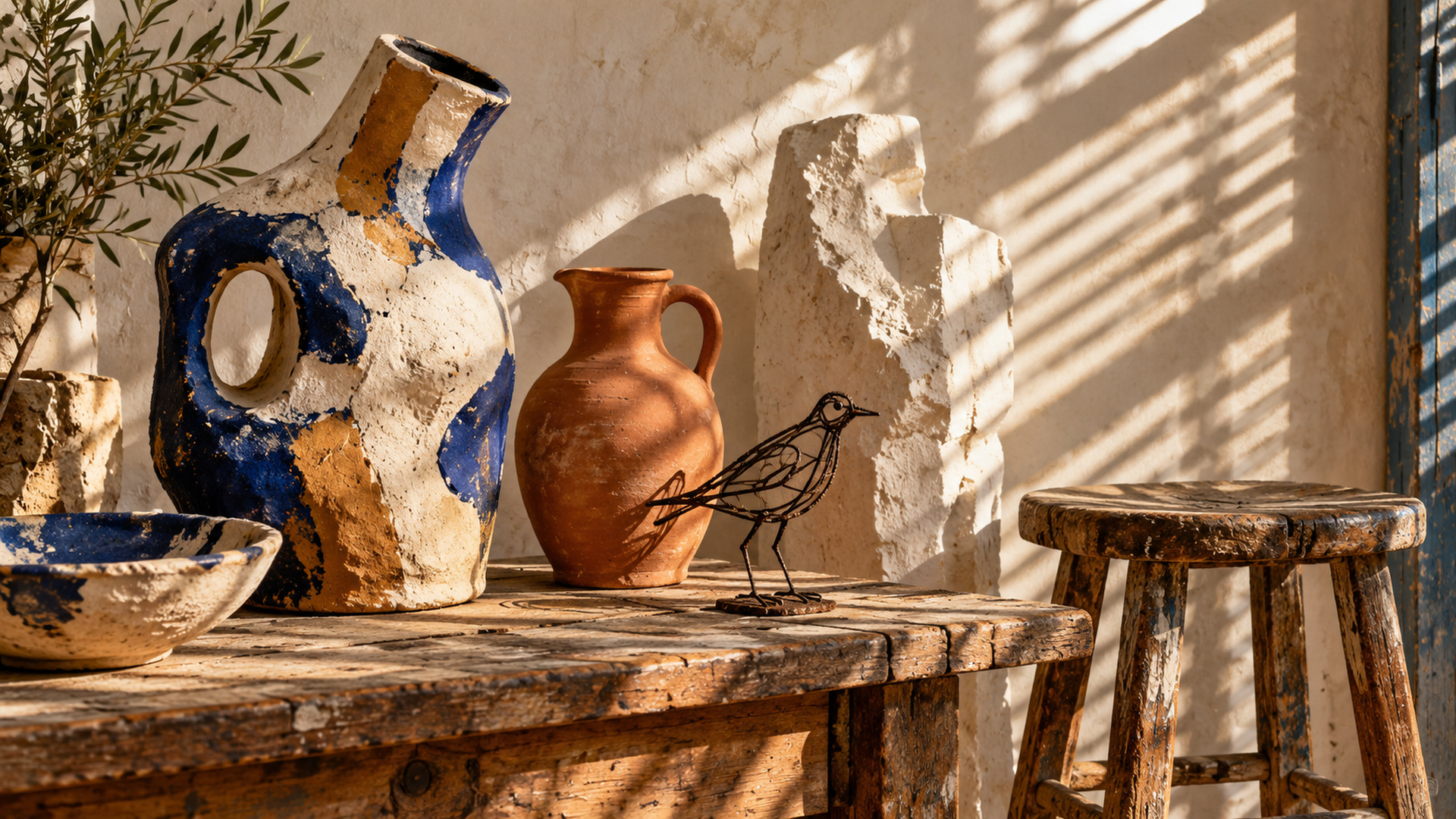
Ceramics likewise placed the artist inside a craft with established processes and skilled practitioners. A vessel’s shape can become part of its imagery, while a handle or spout can suggest the body of a creature. Painting on a curved fired object differs from painting on a stretched canvas, and workshop expertise matters to the result. Prints offer another version of this material dialogue: plates, tools, paper, and printers affect how an image is realized. The breadth of the career rests partly on taking these different conditions seriously, rather than assuming one famous signature explains every finished object.
The People Around Picasso Had Lives of Their Own
A biography organized only around Picasso’s romantic relationships can reduce women to a sequence of visual styles or emotional functions. Dora Maar and Françoise Gilot were artists with work and ambitions of their own. Maar also photographed the development of Guernica, creating an important record of its making. Recognizing such activity changes a familiar story about inspiration into a fuller account of independent practice, exchange, and unequal recognition. The people represented in portraits do not cease to be historical agents because the portraits became famous.
Picasso’s relationships and behavior continue to be examined critically, and admiration for his art should not require treating artistic success as moral permission. At the same time, careful writing should distinguish documented events, first-person testimony, later interpretation, and unsupported anecdote. Sweeping diagnoses of personalities from a distance add drama without necessarily adding understanding. A balanced account can acknowledge the power attached to fame and gender while giving readers the evidence needed to assess particular claims.
This approach also helps with looking. A distorted portrait is not a transparent medical record of its sitter or a complete statement of the relationship. It is a constructed object, made under circumstances that may require separate historical investigation. The biography and picture can illuminate each other without collapsing into one answer. Respect for the people involved means allowing their testimony and their work to exist beyond the role Picasso’s reputation has assigned them.
Fame Grew Larger Than Any Single Picture
Picasso lived through both world wars, became an internationally famous public figure, and died in France in 1973. By then his name could stand for modern art itself, a simplification that made him unusually visible while obscuring the many other artists who shaped the period. The Musée Picasso Paris timeline provides a chronological framework for the long career. Within that framework, exhibition history, collecting, criticism, and reproduction help explain how a maker becomes a cultural symbol. Fame is a historical process as well as a response to remarkable objects. Following that process prevents recognition from becoming circular evidence that every work must be equally great.
How to Look at Picasso Without Memorizing the Myth
Begin with a clear description of what a particular work asks your eye to do. Determine where forms separate, where they merge, and whether the picture offers one continuous viewpoint. Look for an ordinary object that helps establish scale or orientation. Then consider what has changed from a more familiar mode of representation. This sequence gives judgment something concrete to rest on, whether the eventual response is admiration, discomfort, or resistance.
Next, widen the frame to include collaborators, sources, materials, and the people represented. Picasso changed modern art through an extraordinary range of experiments, but those experiments did not happen outside history. They belonged to workshops, markets, friendships, political crises, and unequal encounters between cultures. A biography that keeps those relationships visible can preserve both critical distance and a sense of discovery. The lasting challenge is to see the work clearly enough that the famous name neither does all the looking nor prevents it.