Leonardo Begins at the Workbench
A wing, a folded sleeve, a face turning toward the light: Leonardo da Vinci could treat each as an invitation to investigate how the visible world works. Born in 1452 near Vinci in Tuscany, he became a painter whose reputation now extends far beyond the relatively small group of paintings associated with him. The Mona Lisa and The Last Supper are central to that reputation, but so are drawings of bodies, water, plants, and machines. His biography becomes more interesting when these activities are connected to the practical demands of making art. Leonardo learned in workshops, sought patrons, revised compositions, and sometimes left ambitious projects unresolved. The familiar label of genius describes the scale of his curiosity; it should not hide the training, collaboration, material experiments, and persistent observation that made his achievements possible.
A: He was born in 1452 and died in 1519.
A: His formation included Andrea del Verrocchio's Florentine workshop.
A: The Louvre identifies her as Lisa Gherardini, wife of Francesco del Giocondo.
A: It was painted for the refectory at Santa Maria delle Grazie in Milan.
A: Leonardo's experimental wall-painting technique deteriorated early.
A: It refers to softened tonal transitions rather than emphatic outlines.
A: Drawings document proposals and investigations; successful construction requires separate evidence.
A: Their related compositions contain important differences and a complicated commission history.
A: They reveal an extraordinary historical effort to connect structure, observation, and movement.
A: He lived in France with the support of Francis I.
Florence Taught Him to Make Things
Leonardo’s early life unfolded near Florence, a city where artistic work depended on skilled shops and demanding clients. His father, Ser Piero, was a notary, and his mother was named Caterina. The surviving evidence does not justify turning every uncertainty about his childhood into a prediction of later greatness. What matters for his development is that he entered a setting in which drawing, painting, sculpture, and the handling of materials could be learned together. Andrea del Verrocchio’s workshop provided that environment. An apprentice did not begin as a solitary celebrity; he learned to prepare, observe, assist, and solve practical problems.
Workshop training also makes sense of Leonardo’s ability to move between different kinds of work. A drapery study involves weight, a sculptural figure involves balance, and a painted head involves the behavior of light across a surface. These are related visual problems rather than isolated school subjects. Florence supplied models of ambitious public art and a culture of competition, but it also supplied routines of skilled labor. Leonardo’s later originality grew from that foundation. For readers who know comics production, the useful parallel is apprenticeship in a visual language: a recognizable personal voice develops through learning what a mark can actually accomplish.
Drawing Became a Way of Thinking
Leonardo used drawings for more than preparing attractive finished images. A sheet might test a pose, explore the movement of water, or follow the relation between a muscle and the bone beneath it. The marks preserve acts of inquiry that a polished painting can conceal. Revision is especially revealing: a changed angle or overlapping contour records alternatives considered rather than an effortless answer discovered immediately. Looking at these sheets helps replace the myth of instant inspiration with a more productive account of intelligence at work.
His writing often runs from right to left, an easily sensationalized feature of the notebooks. Mirror writing does not by itself prove that every page was a secret code. More important is the relationship between words and images: text can propose an explanation while diagrams divide a difficult subject into visible parts. The pages are not one tidy modern textbook. They preserve observations, working plans, questions, and occasional assumptions that later knowledge would correct.
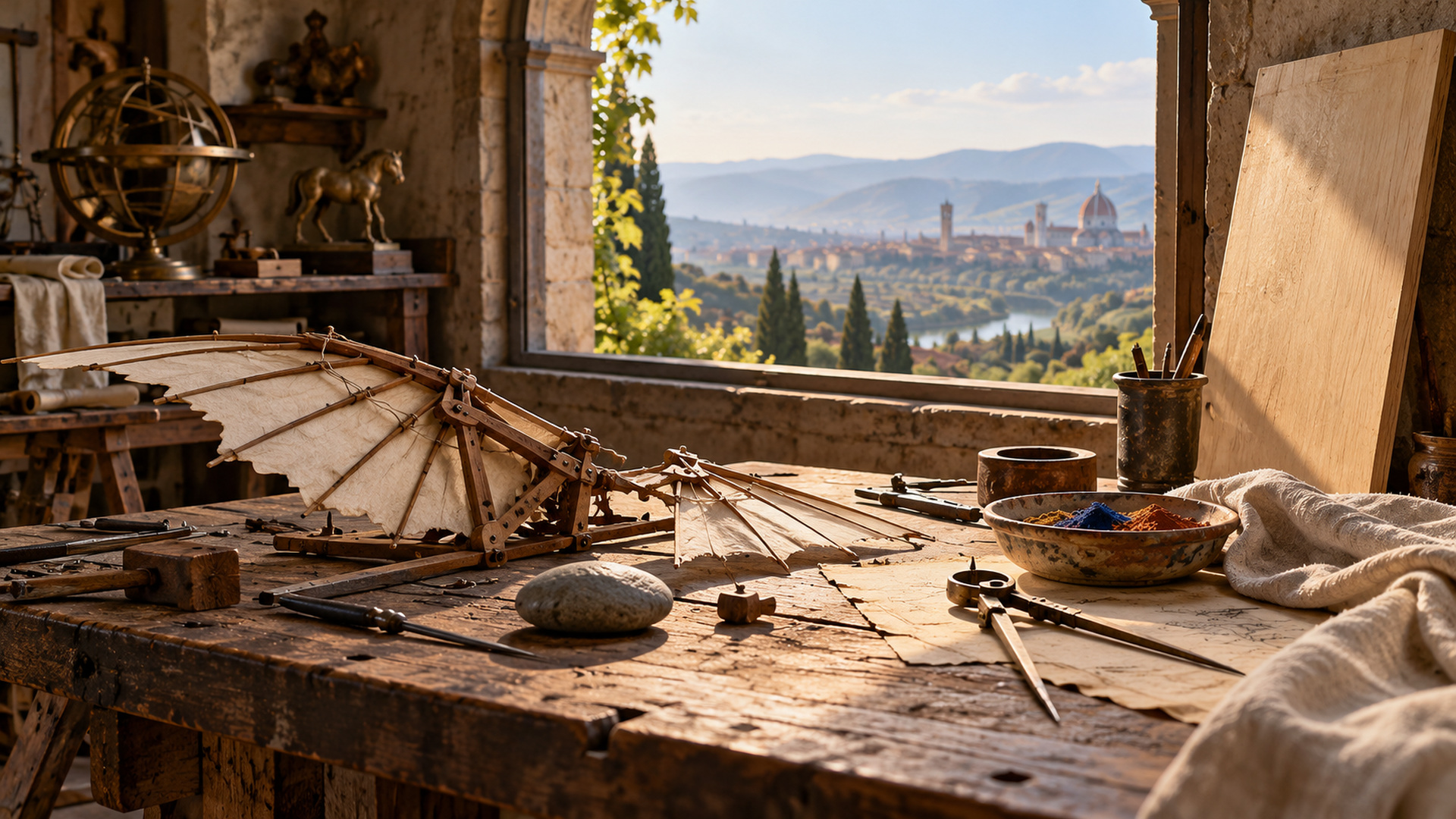
This distinction is important when admiring his mechanical ideas. A persuasive drawing is evidence that an artist explored a mechanism; it is not automatically evidence that a full-scale device was built, powered successfully, or used. Leonardo’s designs reveal ambition and an ability to imagine relationships between parts. Their fascination does not depend on claiming that he completed every invention later enthusiasts associate with his name.
Milan Expanded the Scale of His Ambitions
In the 1480s Leonardo moved into the orbit of the Sforza court in Milan. Court employment could involve painting, engineering proposals, ceremonial design, and large sculptural ambitions, so his range of interests had practical value to a patron. The projected equestrian monument to Francesco Sforza demonstrates both the possibilities and the vulnerability of such work. Planning and a large clay model did not result in the completed bronze monument Leonardo envisioned. Political change and the demands of war could interrupt even a celebrated artist’s opportunities. The Milan years should therefore be understood through both achievements and unrealized commitments. They show someone negotiating a complicated system of service rather than hovering above ordinary professional conditions. That context makes his completed paintings more remarkable, because an ambitious visual idea still had to survive the uncertainties of money, time, materials, and patronage.
Inside the Drama of The Last Supper
Painted for the refectory of Santa Maria delle Grazie in Milan during the 1490s, The Last Supper organizes a familiar religious subject around a sudden human response. Christ announces betrayal, and the apostles react through bodies, hands, and faces. The composition gives these responses structure rather than presenting a disorderly crowd. Groups form along the table, gestures connect neighboring figures, and the surrounding architecture directs attention toward the center. The scene’s power lies in the relationship between a stable overall design and a disturbing event moving through it.
Its physical history also demonstrates the risks of experiment. Leonardo did not use the conventional wet-fresco method that bonds pigment to fresh plaster. The wall painting deteriorated early, and the work viewers encounter has a long history of damage and conservation. The Louvre’s Leonardo exhibition text connects his study of life and movement to this painting while explaining the vulnerability of its technique. The important lesson is not that experimentation always triumphs. Here, an extraordinary narrative invention and a fragile material decision coexist in the same object, and both belong in an honest biography.
For a viewer approaching the image as visual storytelling, the crucial event is not a physical action such as a battle. It is information entering a room and changing the people inside it. Leonardo makes an invisible disturbance visible through differences of reaction. One figure appears to seek an explanation, another turns toward a neighbor, and the overall pattern carries attention outward and back. This is a demanding narrative problem because the painting must suggest unfolding time while remaining a single still arrangement. Its clarity depends on contrast between responses, not on giving every person the same emphatic gesture.
The architectural setting also matters to the experience. Painted space extends the scene beyond the immediate surface, while the long table separates the viewer from the figures without making them remote. Reproductions often crop away the surrounding room or alter the image proportions, weakening an important part of the design. When possible, study an installation view as well as a close photograph. The work was made for a particular communal space, where its subject and arrangement entered the daily life of the people eating there. Recovering that setting adds purpose to a composition that fame can otherwise detach from its original use.
The Mona Lisa Rewards Slow Looking
The portrait known as the Mona Lisa depicts Lisa Gherardini, the wife of Francesco del Giocondo. Leonardo began it in the early sixteenth century, and its extended development resists a neat story about a single inspired sitting. The Louvre’s collection record provides the identification and historical context. Its modern fame can make the actual picture surprisingly difficult to notice. Before looking for a mystery in the smile, attend to the quiet arrangement of hands, the turned body, and the way the figure occupies the space before the landscape.
Leonardo’s use of soft transitions, often discussed under the term sfumato, helps explain the portrait’s unusual presence. Edges do not behave like a firm outline placed around every feature. Light and shadow move gradually across the face, and the viewer has to complete some relationships through looking. The expression can feel elusive because the painting offers subtle visual information rather than a single emphatic signal. That effect is a practical achievement in paint, not evidence that the portrait needs an extravagant hidden message to be significant.
The landscape matters as well. Roads, water, rock, and distance make the figure part of a larger visual world, while differences in clarity help establish depth. A reproduction shrunk onto a phone may flatten these relationships into a familiar icon. Slower looking restores the painting’s carefully managed interaction between near and far. Its appeal can then be understood through choices the artist made, alongside the later fame that museums, reproductions, and public attention added.
Nature and Anatomy Fed the Painter’s Eye
Leonardo’s investigations of the body joined anatomical curiosity to artistic purpose. He sought to understand internal structures and their connection to movement, producing drawings that can combine close observation with the explanatory ambitions of a diagram. The Royal Collection’s account of his anatomical studies places this work in the development of his scientific interests. These sheets deserve attention as historical investigations rather than illustrations of everything modern medicine knows. Their authority comes from the seriousness of the inquiry, not from being flawless in every detail. Similar habits animate his studies of plants and water: he follows structure, growth, and movement instead of using nature only as decorative background. The painter and investigator meet in the wish to understand why an appearance takes the form it does.
One Composition Can Contain Years of Decisions
The Virgin of the Rocks offers another route into Leonardo’s working habits. Versions in Paris and London belong to a complicated commission history, so they should not be treated as interchangeable duplicates. In the London painting, bodies, hands, and glances establish a carefully organized group within a rocky setting. Nature becomes an environment that shapes the sacred scene. The National Gallery’s painting entry explains the relationship of its picture to the earlier version and discusses the significance of the setting.
Comparing related works reveals how misleading it is to imagine a masterpiece arriving fully formed. Adjustments to gestures or lighting can change the emotional balance of a scene even when its principal figures remain similar. Technical study can also disclose decisions beneath the visible surface, reminding viewers that a painting has a history of making. Attribution may require distinguishing the master’s work from the activities of assistants and followers. Those distinctions strengthen appreciation by giving collaboration and revision their proper place, rather than making every object near Leonardo evidence of an identical personal touch.
France, Survival, and the Making of a Reputation
Leonardo spent his final years in France under the patronage of Francis I and died in 1519. The move belongs to a long career shaped by changes of place and political opportunity. It should not turn the preceding decades into a simple march toward royal recognition. His surviving output is uneven across media: relatively few paintings coexist with a remarkable body of drawings and writings. That imbalance explains why his reputation cannot be measured only by counting completed canvases or checking which ambitious proposals became usable machines.
Later generations also helped create the Leonardo they wanted to admire. Some emphasized the perfect painter, others the scientific visionary, and popular culture frequently combines them into a person capable of almost anything. These portraits can be exciting, but they tend to erase limits and uncertainty. A more substantial admiration can accommodate unfinished commissions, experiments that failed materially, and observations that did not become public scientific publications. The achievement remains extraordinary without turning historical evidence into an unlimited certificate of genius.
For a first encounter, choose a painting and one related group of drawings, then ask what each makes visible. Watch how a hand expresses attention, how light describes a cheek, or how a sequence of sketches breaks a movement into parts. This approach also explains Leonardo’s relevance to visual storytelling: observation is transformed into a design that guides another person’s eye. His life offers no shortcut around practice. It offers a demanding example of curiosity made concrete through materials, repeated decisions, and the effort to look more carefully than habit requires.