Marvel’s Empire Began With the Need to Publish the Next Issue
The modern Marvel name suggests a vast supply of heroes, films, merchandise, and interconnected stories, but its history did not begin with a complete plan for that outcome. It began in the competitive business of selling printed entertainment, where publishers followed changing tastes, creators worked under practical constraints, and a successful character did not guarantee a secure company. The route from the comics associated with Martin Goodman to a worldwide entertainment identity passed through several publishing eras, unexpected revivals, artistic partnerships, corporate changes, and a severe financial crisis. Understanding that route requires keeping business history beside creative history. Ownership explains who controlled a catalogue, while credits explain who made the stories inside it. The two overlap, but neither can replace the other. Marvel’s growth becomes more interesting when its future is allowed to remain uncertain at each stage instead of being treated as inevitable from the first issue.
A: No. The initial comic contained several features within an early publishing business.
A: No. The earlier Human Torch is an android character.
A: They reveal the variety of the publisher's history and the work before its modern superhero expansion.
A: No. Distinct artists, writers, and other collaborators made essential contributions.
A: No. Serial worlds can accumulate through new stories, revisions, and later connections.
A: It refers to the specialist comic-shop distribution system that became increasingly important.
A: Marvel and related holding companies filed Chapter 11 petitions in December 1996.
A: Yes. Corporate finances depend on more than the popularity of individual properties.
A: No. Iron Man opened in 2008; the acquisition agreement was announced in August 2009.
A: The credited creative work that makes individual comics rewarding to read.
1939: A Comic Book Joins a Publisher’s Business
Marvel traces its beginnings to Marvel Comics #1 in 1939, issued within Martin Goodman’s publishing operations. The early company is commonly discussed through the Timely name, although its actual corporate and publishing identities were more complicated than a single modern brand. The first issue brought together several features rather than unveiling the fully formed superhero universe familiar to later readers.
Marvel’s Golden Age reading guide points readers toward this opening period, including the original Human Torch and the Sub-Mariner. Carl Burgos and Bill Everett belong to the creative history of those characters. The Human Torch of this era is the android hero, a distinction that matters when later Marvel history introduces Johnny Storm under the same name.
Captain America Makes the Early Identity More Visible
Captain America arrived through the collaboration of Joe Simon and Jack Kirby, adding an enduring figure to the early publishing catalogue. The character’s unmistakable wartime context demonstrates how superhero comics could respond directly to public events and political feeling. The imagery was an argument as well as entertainment, and its historical setting should remain visible when readers look back from a much later version of the character.
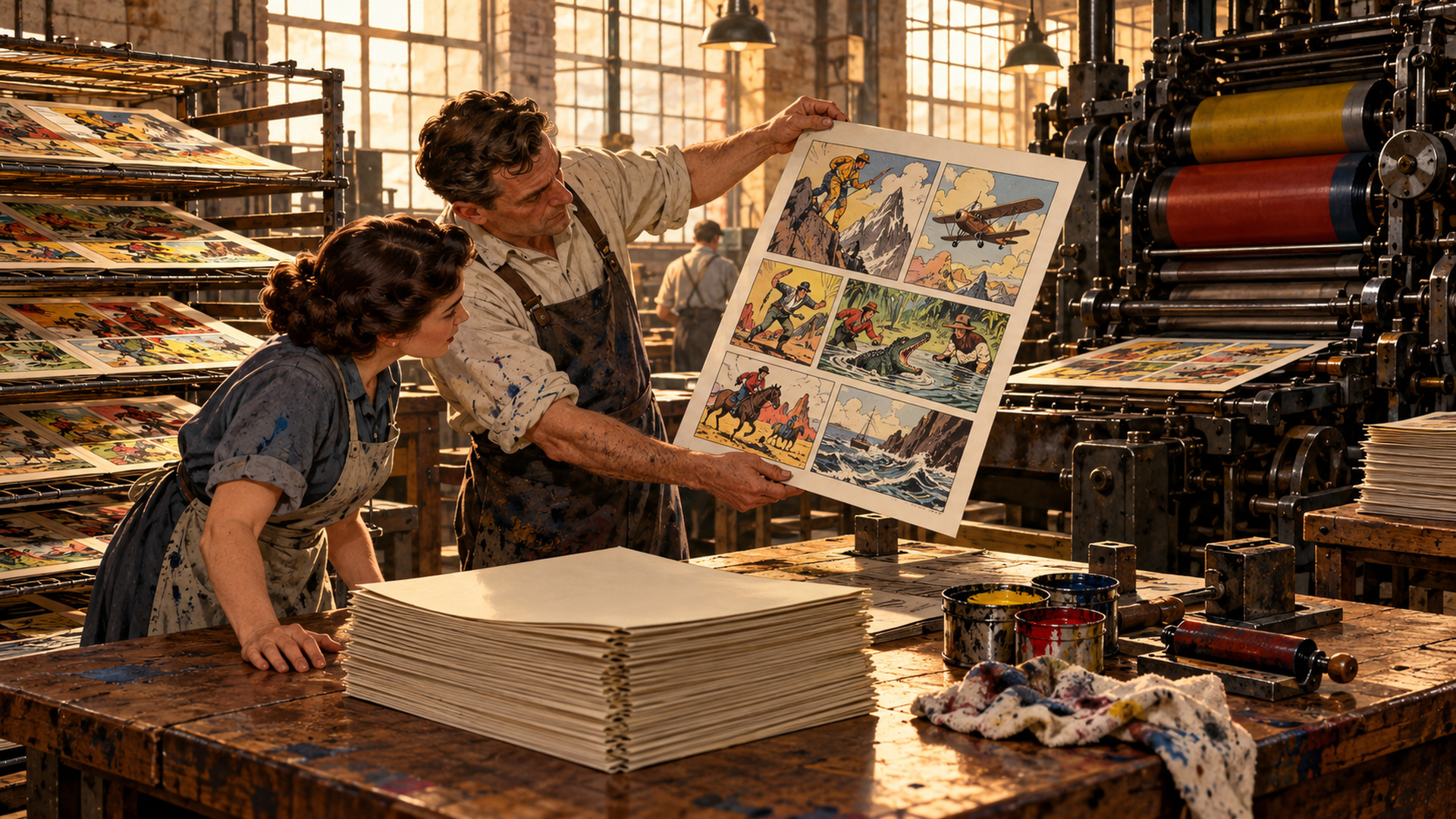
A successful feature still depended on an entire production and distribution system. Stories had to be completed, printed, delivered, and sold often enough to keep the business moving. Editors, artists, writers, letterers, colorists, and production workers all participated. Recognizing that practical network prevents early publishing history from becoming only a parade of famous first appearances.
It also prevents ownership from swallowing authorship. Goodman controlled a publishing enterprise, but that fact does not make him the artist or writer of every property it released. Conversely, the creative significance of Simon, Kirby, Burgos, Everett, and their contemporaries does not by itself explain the company’s business decisions. Both histories are necessary to understand what the early publisher actually was.
Looking through a complete early issue also reveals priorities that a reproduced cover cannot show. Different features compete for space, and the transition between them changes the reading experience. A publisher is offering an assortment as well as promoting a star. That distinction helps explain why the later history should follow changing formats and catalogues alongside famous characters: the company had to decide what a purchaser would actually receive inside each physical comic.
The Atlas Years Were More Than a Waiting Room
The 1950s period commonly associated with Atlas included a broad range of genres, from horror and science fiction to westerns, romance, humor, and other forms. It should not be reduced to an uneventful pause before superheroes returned. Publishers were responding to audiences and a changing industry, and creators developed skills across assignments with different rhythms and expectations. Marvel’s account of Jimmy Woo’s early history provides one route into this era beyond the best-known superhero names. A reader who encounters only later revivals can miss how much of the company’s catalogue originated in a more varied publishing environment.
1961: The Fantastic Four Give the Publisher a New Center
Stan Lee and Jack Kirby’s Fantastic Four launched in 1961 and became a central turning point in modern Marvel history. The team combined extraordinary adventure with quarrels, visible personalities, and relationships that could carry consequences between issues. Marvel’s guide to the early series identifies the Lee-Kirby collaboration and directs readers to the original run.
The innovation should not be exaggerated into a claim that no earlier comic contained flawed people or continuing relationships. The important point is the particular combination and the way it developed within this expanding line. Exploration, family friction, humor, resentment, spectacle, and recurring adversaries could coexist. The series supplied both individual adventures and a setting large enough to invite further invention.
A Growing Universe Needs Many Different Creative Partners
Spider-Man, the Hulk, Thor, Iron Man, the X-Men, and the Avengers helped make the early 1960s an extraordinarily productive period. Their histories involve distinct combinations of contributors, including Lee, Kirby, Steve Ditko, Don Heck, Larry Lieber, and others. Accurate credit requires looking at each property and issue rather than assigning the whole period to one celebrity. A shared company identity does not make the work creatively uniform. Nor does a later film credit resolve every historical question about how a particular comic developed. The pages themselves, their original credits, and documentary accounts provide different kinds of evidence. Where memories conflict, a concise history should acknowledge that complexity instead of turning a convenient promotional story into a universal explanation. The publisher’s achievement rests partly in the breadth of that creative network: different people could supply different kinds of imagination, and readers could discover preferences among them. Recognizing the network makes the growth more concrete, since the fictional universe depended on assignments being made and actual pages being delivered rather than on a brand name acting by itself.
Ditko’s visual storytelling and characterization, for example, cannot be treated as interchangeable with Kirby’s. Their pages organize action, space, and human tension differently. Those differences helped the line offer recognizable variety within a connected world. Readers could feel that the books belonged together without every hero living in precisely the same kind of story.
The universe grew through repeated work rather than through a finished master plan published all at once. Supporting characters became important, opponents returned, and stray ideas acquired new uses. Later continuity could connect elements that had begun in more independent circumstances. Remembering that accumulation makes the history less tidy but more faithful to how serialized comics actually develop.
Connection Turns Separate Purchases Into an Ongoing Conversation
Marvel’s shared setting gave a reader reasons to look beyond one favorite title. A guest appearance could introduce a different hero, an event could leave consequences elsewhere, and a familiar New York location could make separate adventures feel adjacent. Editorial pages and letters reinforced a sense of continuing participation. This relationship had commercial advantages because one book could encourage interest in another, but its appeal also depended on pleasure: the recognition of a familiar face in an unfamiliar story. The same system created coordination problems, since an expanding world needed enough consistency to reward attention without demanding that every newcomer complete a research project before beginning.
The 1970s and 1980s Expand the Publishing Possibilities
As new generations of writers and artists entered the company, Marvel’s range developed beyond the original early-1960s configuration. Established heroes acquired different voices, genres mixed, and long-running series found fresh dramatic engines. The growth of the X-Men is one obvious example of a property whose later prominence cannot be understood solely from its first appearance. Continued collaboration and changing creative teams matter to the outcome.
Publishing formats also developed. Graphic novels, specialized projects, licensed material, and initiatives associated with Epic offered routes that differed from the standard superhero monthly. These experiments did not remove the importance of the core catalogue. They show that Marvel’s publishing history includes efforts to reach readers through different sizes, formats, rights arrangements, and expectations, with varying degrees of commercial and artistic success.
The Direct Market Changes the Relationship With Readers
Comic specialty stores became increasingly important to the business of American comic-book publishing. The direct market supported committed audiences and made room for material that did not depend on the same sales pattern as a newsstand comic. For Marvel, it offered a closer relationship with readers who followed creators, continuity, and collecting. That relationship helped support both enduring series and specialized experiments.
The arrangement also changed the kinds of commercial signals the company received. Orders placed by retailers are not identical to the number of people who ultimately read a comic. Collector enthusiasm can increase demand for an object independently of the reading experience inside it. Distinguishing these things becomes essential when assessing the boom years that followed.
No distribution system makes a publisher immune to mistakes. A company may possess popular characters and still misjudge expansion, demand, debt, or the resilience of its retail network. The later crisis cannot be explained merely by deciding whether readers liked a particular crossover. Business structure and industry conditions belong beside the creative decisions in any serious account.
The 1990s Bring Spectacle and a Severe Financial Crisis
The early 1990s combined intense attention to superhero comics with speculation and rapid commercial expansion across the industry. That excitement did not provide a stable guarantee of future demand. Marvel and related holding companies filed for Chapter 11 protection in December 1996, a date recorded in the federal court’s account of the proceedings. Bankruptcy is a corporate and financial event, not proof that every comic published at the time lacked artistic value. Equally, beloved characters did not protect the enterprise from the consequences of its financial situation. The crisis is one of the clearest reasons to reject the idea that the company’s eventual global position had always been assured.
Recovery Includes Comics as Well as Screen Possibilities
Recovery cannot be reduced to a single hero or one editorial rescue. Corporate restructuring, licensing, business decisions, and continuing creative work all belong to the story. On the publishing side, Marvel Knights provided a focused experiment in selecting characters and assembling teams with distinctive approaches. Its late-1990s history is documented through Marvel’s oral history with participants.
Screen adaptations and licensing subsequently enlarged the public reach of Marvel characters. These activities were connected to the catalogue without being identical to publishing monthly comics. A film audience could know a character through an adaptation while remaining unfamiliar with the issue credits, earlier versions, or publishing circumstances. The brand could grow far beyond the readership that originally sustained its fictional world.
Marvel Studios and Disney Change the Scale
Marvel Studios’ development of interconnected films brought a publishing-derived idea to a different medium, with its own actors, directors, writers, designers, producers, and business arrangements. Iron Man’s 2008 release is a major landmark in that story, but the relationship between comic continuity and screen continuity requires care. An adaptation selects and changes material; it does not simply display the complete history of the original pages.
Disney announced its agreement to acquire Marvel Entertainment in August 2009, describing the transaction and its broader corporate ambitions in its acquisition announcement. That event placed Marvel within a larger entertainment organization. It did not retroactively make Disney the publisher responsible for the original 1939 issue or the artistic partner who created the 1960s characters.
The scale of recognition can now obscure the modest material unit at the center of the history: people producing sequential pages for other people to read. Those pages remain worth examining independently of adaptations or corporate prestige. Their specific artistic choices explain why a character mattered before, during, and beyond a period of spectacular mass visibility.
Read the History as Several Connected Stories
Marvel’s rise brings together a publishing business, a changing workforce of creators, a fictional universe, a collecting culture, and a catalogue adapted into other media. None of those strands alone explains the result. Reading an early Timely issue, an Atlas genre story, a Lee-Kirby or Lee-Ditko collaboration, and a later reinvention reveals real differences beneath the continuous brand. The empire grew through accumulated work and repeated uncertainty, while its most enduring resource remained the ability of distinct creative teams to make a reader care about the next page.