Before the familiar shield, a publishing experiment
DC Comics can look inevitable when its history is viewed backward from Superman and Batman. Put those two figures on a shelf, add decades of adaptations, and an enormous entertainment institution seems to explain itself. The beginning was considerably less settled. Publishers experimented with comic book formats, artists and writers worked under demanding commercial conditions, and a new kind of costumed adventure found an audience before anyone could know how durable it would become. Understanding that development means separating the histories of the characters from the history of the company that published them. Superman and Batman supplied distinctive imaginative possibilities, but editors, distributors, other creators, and generations of readers helped turn individual successes into a continuing publishing culture. Follow the actual publications rather than an imagined master plan, and DC becomes a more interesting story: an institution repeatedly rebuilt around recognizable heroes while the meaning of those heroes kept changing.
A: No. Early anthologies included multiple genres before superhero features became defining successes.
A: It reveals a publishing experiment that predates the best-known breakthrough.
A: No. His debut appeared in Detective Comics #27.
A: No. DC identifies a March arrival for the issue carrying that cover date.
A: They require context because company names and publishing relationships changed.
A: No. The revival introduced a different character using the established heroic name.
A: They helped stories accommodate different versions and generations of characters.
A: Yes. Later fictional revisions do not erase an earlier issue’s publication or influence.
A: No. It is a publishing imprint with a different function from a fictional group.
A: Compare actual issues from distinct periods while tracking creators, format, and editorial context.
Original material before superheroes took over
One useful starting point is New Fun, which began in 1935 under Major Malcolm Wheeler-Nicholson. Rather than simply repackaging familiar newspaper strips, it presented original material in an anthology format. DC’s own historical edition of the first issue identifies that experiment as an important part of its publishing ancestry. The point is not that one magazine already contained everything modern readers associate with DC. It established a space in which new properties and new working relationships could develop.
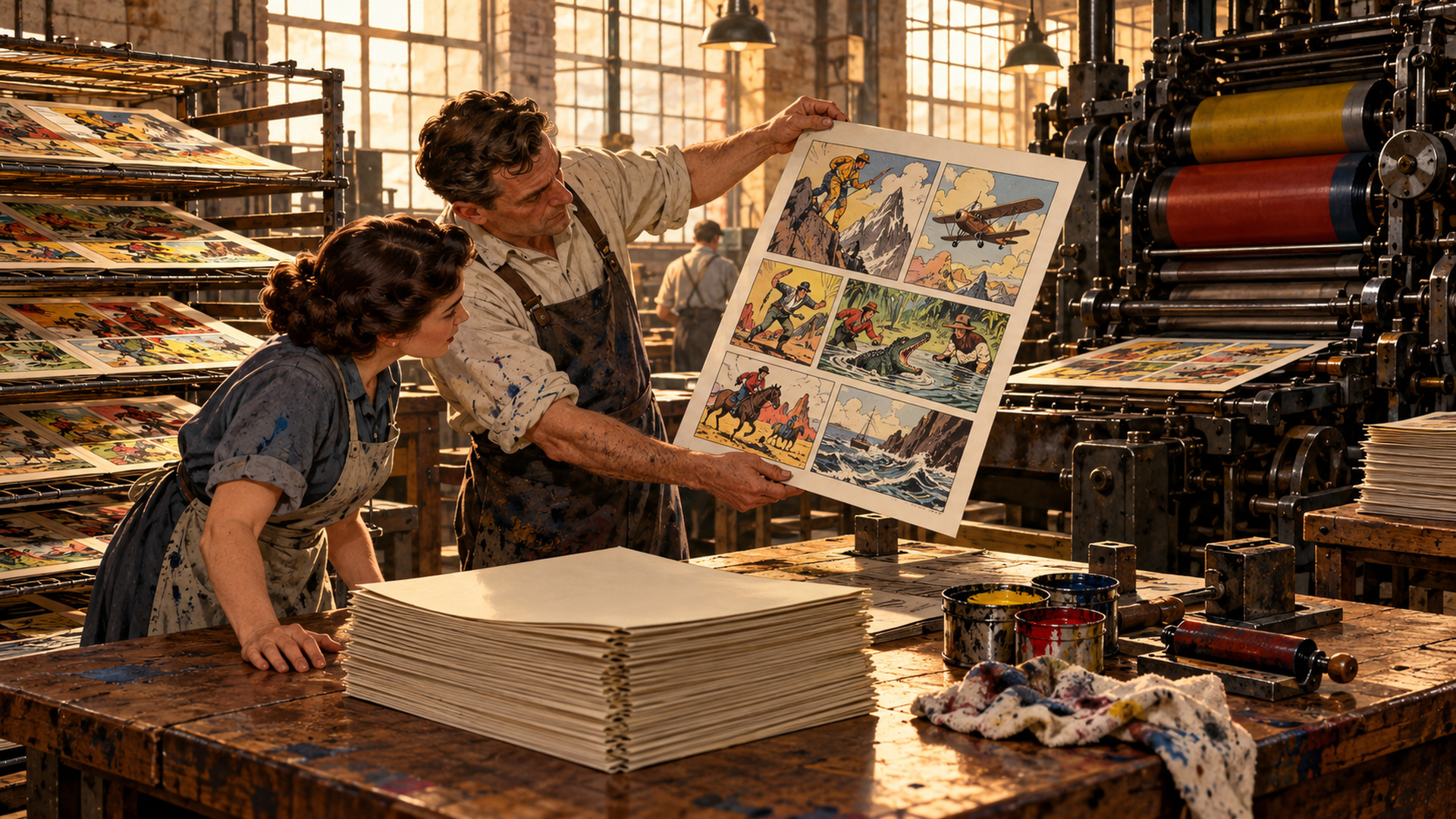
The early comic book was a container for several kinds of entertainment. Humor, adventure, detective material, and other features could sit together, inviting readers who had not yet organized their tastes around superhero universes. That mixed environment helps explain why the later superhero breakthrough was a change within an existing business. It did not arrive on an otherwise empty newsstand, nor did it instantly erase competing genres.
The corporate ancestry is also less straightforward than a single founder building a single stable firm. The companies and publishing relationships behind National, Detective Comics, and All-American contributed to what readers eventually recognized as DC. Keeping that complexity in view prevents a familiar mistake: treating every early publication as though it had emerged from a unified modern organization with the same branding and priorities.
Superman changes what an adventure feature can promise
Jerry Siegel and Joe Shuster’s Superman appeared in Action Comics #1 in 1938. The Smithsonian’s collection record places the issue within the material history of American popular culture, a useful reminder that this was a printed commercial object before it became a cultural monument. Its famous hero offered an immediately legible combination: extraordinary physical power, a recognizable human setting, and the possibility that intimidating institutions could be challenged.
Superman’s early appeal did not require the full mythology accumulated across later decades. Readers could understand the figure through action, visual contrast, and the relationship between an imposing costumed champion and the ordinary identity of Clark Kent. That flexibility mattered commercially. A clear central idea could support further stories while inviting new situations, supporting characters, and explanations that were not all fixed at the first appearance.
Batman supplies a different engine for recurring stories
Batman arrived in Detective Comics #27 in 1939, with Bob Kane and Bill Finger central to the character’s creation. DC’s account of the beginning distinguishes the issue’s May cover date from its March newsstand arrival. Even this small detail illustrates why publication history needs care. A date printed on a cover is evidence, but it does not automatically tell you when a reader could buy the comic.
Batman brought a different set of recurring pleasures into the developing superhero field. Disguise, investigation, theatrical fear, strange crimes, and the tension between vulnerability and preparation could drive a story without reproducing Superman’s powers. The contrast gave the publisher two especially durable approaches to adventure. It also allowed readers to move between different emotional temperatures while staying within a broadly recognizable costumed-hero tradition.
Neither character remained unchanged after his debut. Supporting casts, visual conventions, settings, moral boundaries, and story rhythms developed through continued publication and additional creators. Describing the first appearance as the complete modern character would flatten that development. A more accurate history treats invention as consequential and revision as consequential too, with different contributors responsible for different parts of the accumulated result.
Two famous names never constituted the whole catalog
The wider publishing family included many more voices and characters, including Wonder Woman and the heroes associated with All-American. Their importance is not merely that they filled spaces around two male stars. They introduced different imaginative traditions, audiences, and possibilities for collective storytelling. Looking beyond the most familiar covers also restores attention to humor, romance, war, western, and other comics that shaped the business when superhero popularity fluctuated. A publisher’s identity can become more selective in public memory than its actual output ever was.
Editorial continuity makes individual successes repeatable
A successful character needs a production system if readers are to encounter that character regularly. Editors commission and coordinate work, creative teams solve recurring narrative problems, and publishers organize issues into products that can reach a market. Those practical operations are less visible than a dramatic cover, but they help explain how a hit becomes an enduring line. Repetition requires institutional memory as well as fresh invention.
That institutional memory can preserve a hero’s appeal while also constraining experimentation. An editor may want an unfamiliar situation to feel immediately recognizable, or a new contributor may inherit expectations established by earlier stories. DC’s history repeatedly involves that negotiation. The question is seldom simply whether a character changes; it is which changes become part of the continuing version and which remain attached to a particular run.
The superhero revival gives old ideas new arrangements
Superhero publication did not proceed as an uninterrupted expansion from 1938 onward. The postwar market supported other genres, and some costumed figures lost their titles while a smaller set remained visible. Acknowledging that unevenness makes the later revival more intelligible. Publishers were responding to changing conditions, rather than merely waiting to execute a predetermined sequence of eras.
The introduction of a new Flash in Showcase #4 in 1956 is a useful landmark. The Library of Congress overview of the Silver Age situates this development within a broader revival. The new version reused a recognizable heroic name while changing the person, visual identity, and surrounding circumstances. That combination demonstrated that inherited material could become a platform for a contemporary creative proposal.
Revival also created opportunities for teams and connections between features. Once heroes could meet, their separate stories could imply a larger world, giving readers additional reasons to follow the line. This was not just a matter of adding more characters to a scene. A shared setting changes expectations about consequences, compatibility, and what readers need to remember between issues.
A shared universe becomes a problem worth solving
DC’s multiple versions of familiar heroes generated imaginative opportunities and organizational challenges. Earlier characters and later reinventions did not always fit neatly into one unqualified history. Stories involving parallel worlds offered one way to preserve differences without pretending they had never existed. The attraction was creative as well as administrative: an apparent contradiction could become the premise for a meeting, a mystery, or an entire adventure.
Later large-scale events reorganized continuity again, sometimes simplifying one area while generating fresh complications elsewhere. Readers therefore benefit from asking which era and series a historical claim describes. A character’s publishing history includes stories that later continuity may revise or exclude. Removing a story from a current fictional timeline does not remove it from the real history of the comic book.
Different publishing lines widen the meaning of DC
The company’s identity also expanded through material that did not fit the model of a conventional ongoing superhero title. Distinct publishing lines could signal different audiences, formats, or creative expectations, helping readers understand what kind of experience they were being offered. This signaling matters because a familiar corporate name alone cannot explain the tone or intended readership of every book bearing its association.
Vertigo’s 1993 launch is an important historical example, gathering and developing work associated with mature readerships and a wider range of genres. Black Label, introduced in 2018, represents another approach to distinguishing selected projects within DC’s publishing landscape. DC’s history of its imprints is useful for tracing these distinctions. Their names should be read in their particular historical contexts rather than treated as interchangeable quality grades.
Such lines complicate the claim that DC history is simply the history of its most famous fictional universe. They also reveal how publishing categories can help experimentation find an audience. A reader may enter through Batman and later discover a radically different kind of comic through another part of the catalog. The institution grows partly by making those different encounters possible.
Adaptations amplify an identity built in print
Film, television, animation, and other adaptations have made Superman and Batman familiar to people who may never have read their earliest comics. That reach can make a screen interpretation seem like the definitive original, especially when its imagery dominates a particular generation’s experience. Historically, however, adaptation is a selection and transformation of available material. It can influence later comics in turn, but it does not collapse all previous versions into a single continuous portrayal. Comparing media works best when their distinct contributors, production conditions, and storytelling capacities remain visible.
Reading the legend without losing the people
The strongest introduction to DC history keeps several scales in view at once. First appearances identify decisive publication moments; creator credits identify human contributions; editorial and business history explain how work continued; and reader reception helps explain what lasted. No single scale replaces the others. A famous image becomes more meaningful when its making and circulation are part of the account.
Superman and Batman helped build a comic book legend because their central ideas could survive repeated interpretation. The publisher helped sustain that process through a changing catalog, creative workforce, and set of institutions. Reading early issues alongside later reinventions makes the history tangible: you can see both the recognizable promise and the work required to renew it. DC’s durability lies in that continuing exchange between memorable inventions and the people who keep finding different stories inside them.
Why collecting formats can change the historical view
A modern collection may arrange early stories into a clean sequence that their first readers never experienced. An anthology originally surrounded one feature with unrelated material, advertisements, and competing visual attractions. A collected volume can remove those surroundings and give the impression of a self-contained novel unfolding steadily toward a known destination. Neither format is inherently misleading, but each encourages a different understanding of what the work originally offered and how a reader might have encountered it.
Color reproduction, paper, dimensions, and restoration choices also affect the encounter. A crisp contemporary edition can make a drawing easier to inspect while changing the density and texture of a cheaply printed original. These differences become particularly useful when discussing why early characters appeared visually forceful on a crowded newsstand. Their historical presence belonged partly to objects with particular manufacturing limits, rather than to disembodied images preserved at whatever resolution a modern screen happens to display.
For a beginning reader, the practical response is modest: identify the edition and ask what it preserves. You do not need to own an expensive original issue to study the history responsibly. A well-documented reprint, an institutional scan, and a careful publication record can answer many introductory questions. The aim is simply to distinguish the story on the page from the later packaging that makes it available, giving both their proper place in DC’s long relationship with readers.