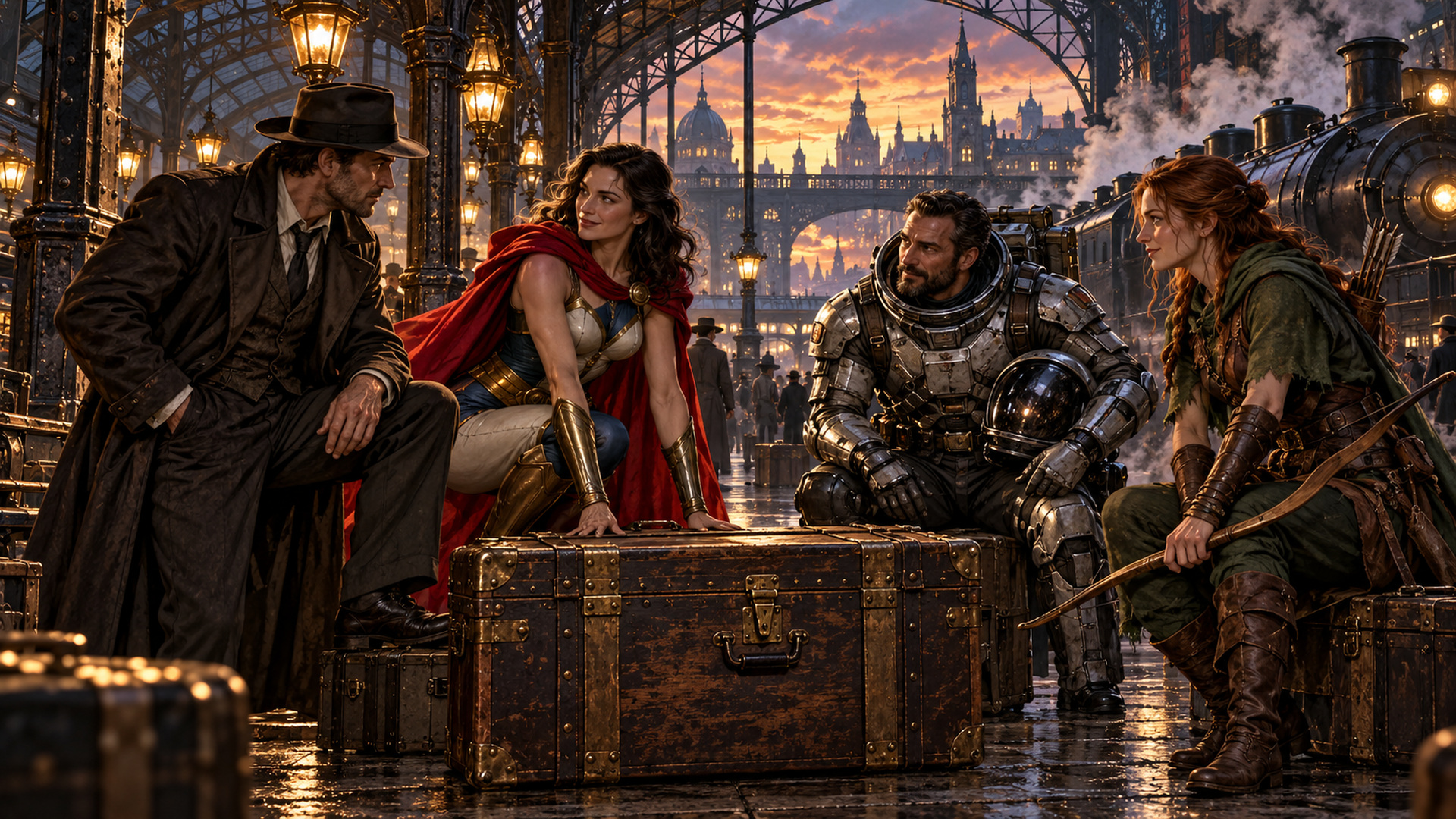
When a Meeting Changes the Story
The first appeal of a crossover is easy to understand: people who normally occupy different corners of an imaginative world finally meet. The harder achievement is giving that meeting a reason to matter after the surprise wears off. A strong crossover creates choices that the separate stories could not produce as effectively, makes an unfamiliar relationship feel consequential, or changes how a shared setting understands its own history. This editorial ranking weighs those qualities across ten influential encounters and events. It includes compact meetings, coordinated publishing stories, alternate-world experiments, and interpublisher cooperation, while distinguishing them from one another. The placements prioritize narrative integration, emotional stakes, visual clarity, and lasting imaginative usefulness. They do not measure sales, the size of a cast, or which company’s characters would win a hypothetical fight.
A: Events can combine different structures, from compact meetings to coordinated lines and central miniseries.
A: The ranking considers meaningful encounters as well as publishing scale.
A: The participants need distinct dramatic uses; recognition alone does not supply integration.
A: They are separate works with different dates, structures, and central conflicts.
A: Its meeting makes the traditions and assumptions of two worlds part of the drama.
A: Emotional, formal, and relational consequences can remain significant after later continuity revisions.
A: Identify the core narrative and relevant preparation, then choose optional branches deliberately.
A: Changed circumstances can reveal character and relationships rather than offer only redesigned appearances.
A: Balloon placement and reading order help a crowded conversation remain understandable even when many recognizable people share the panel.
A: Notice encounters that change judgments, require cooperation, or produce consequences beyond the immediate fight.
What This Ranking Means by a Crossover
A crossover brings previously separate characters, titles, or settings into a meaningful shared narrative. The result can occupy one issue or a large network of publications. An event is a broader publishing arrangement and may include many crossovers, while a simple guest appearance need not reorganize anything around the visitor. These categories overlap, but they should not be used as though they describe the same reading experience.
The ranking is intentionally subjective. A reader who values easy entry may prefer a compact encounter, while someone invested in a long-running universe may value the payoff of accumulated history. The explanations make those priorities visible. The central criterion is whether the meeting produces more than recognition.
10. Flash of Two Worlds: A Small Meeting With Large Possibilities
The meeting between Barry Allen and Jay Garrick in The Flash #123 gives a comparatively compact encounter an unusually large imaginative future. Two heroic generations can inhabit distinct worlds and still become available to one another. The idea turns a difference in publishing history into material for an adventure, making earlier stories part of a wider possibility rather than simply an abandoned past. It earns this place because a clear dramatic meeting can generate a framework that later creators use far beyond the scale of the original episode.
9. Secret Wars: A Cast Becomes a Pressure Chamber
The original 1984 Secret Wars gathers familiar Marvel heroes and villains within a premise designed to force encounters. Its immediate pleasure lies in interactions among people who do not normally share the same space. Rivalries, alliances, and contrasting temperaments become visible because the story removes them from their usual surroundings.
The arrangement also reveals a recurring strength and risk of the form. A large cast offers many appealing combinations, but an appearance is not the same thing as a useful dramatic role. The event is most rewarding when attention to personality gives the gathering a shape, allowing readers to follow choices rather than count costumes.
8. Inferno: Several Stories Share an Unsettling Atmosphere
Inferno uses a supernatural crisis to connect parts of Marvel’s world through a common disturbance. The premise can move between personal conflict and a city whose familiar physical environment becomes threatening. That shared atmosphere provides a form of unity different from assigning everyone the same mission.
The strongest crossover effects occur when each title’s existing relationships make the disturbance feel different. An event becomes richer if it can produce fear in one setting, bitter family pressure in another, and a new tactical difficulty elsewhere. A common premise does not have to flatten every participating book into the same emotional experience.
It ranks here for that capacity to make a setting feel affected at several scales. The city is not only a backdrop for one decisive battle. It becomes a place where different lives register the same crisis, making shared continuity tangible through consequences rather than through a roll call.
7. Mutant Massacre: Consequences Extend Beyond the Main Confrontation
Mutant Massacre connects X-Men-related lives through an assault whose aftermath matters as much as the initial emergency. Injury, survival, displacement, and responsibility give the event an emotional reach beyond the number of participants. Its place in the ranking rests on that principle: a crossover gains weight when the separate books carry consequences that cannot be settled by a concluding group pose. The shared story changes what characters must live with afterward, making coordination useful to characterization rather than only to the mechanics of an event.
6. Age of Apocalypse: Familiar People Under Different Conditions
Age of Apocalypse uses an altered world to make recognition unstable. Familiar names remain useful, but their relationships and circumstances cannot be assumed. The premise invites readers to compare who a character becomes when the world around them develops differently. That is more substantial than changing a costume for novelty.
The coordinated format helps make the alternate setting feel inhabited. Different titles can imply a larger society, supplying perspectives that one central plot might not contain. The event earns its position when those perspectives support a coherent imaginative situation rather than merely provide unrelated variations on familiar figures.
5. Annihilation: A Wider Universe Finds a Shared Emergency
Annihilation makes Marvel’s cosmic setting feel like a connected place under pressure. Characters and regions that can appear distant from Earthbound superhero routines become part of a conflict with its own scale and urgency. The event does not need every famous terrestrial hero to establish importance.
Its appeal lies partly in the way a shared emergency creates meaningful alliances. Different histories and capabilities become relevant to survival, so the gathering can feel like a response to circumstances rather than an obligation to include every available name. Readers gain a sense that the wider universe contains lives with claims of their own.
Marvel’s cosmic-events overview places the conflict within that larger history. The editorial reason for ranking it highly is its ability to give a sprawling setting narrative focus while leaving room for distinct participants. Scale becomes something the story makes understandable rather than simply announces.
4. The Infinity Gauntlet: Immense Power Meets a Character Problem
The Infinity Gauntlet connects cosmic spectacle to Thanos’ desires and limitations. The scale of the threat can dwarf individual heroes, yet the conflict remains interesting because power does not remove the personal contradictions surrounding its use. A gathering of champions becomes part of a story that cannot be understood only as a competition of abilities.
The visual ambition matters, but so does the difference between possessing near-unimaginable capacity and knowing what to do with it. That distinction gives the crossover a recognizable psychological center. Its high placement reflects how effectively a large conflict can remain organized around a problem with a particular character.
3. JLA/Avengers: Two Traditions Recognize and Misread Each Other
Kurt Busiek and George Pérez’s JLA/Avengers makes the differences between two superhero universes part of the meeting itself. The characters bring assumptions about their own worlds into an encounter with another, giving recognition room to become misunderstanding and eventually cooperation. Pérez’s handling of an enormous cast makes the page a place of detailed comparison rather than a simple display of ownership. DC’s collected-edition description identifies the four-issue co-publishing project. It ranks third here because an interpublisher spectacle becomes most satisfying when each tradition has something distinctive to contribute.
2. Secret Wars: A Broken Multiverse Becomes a Personal Argument
The 2015 Secret Wars, by Jonathan Hickman and Esad Ribić, is a different work from the 1984 event with the same name. Its constructed Battleworld gives fragments of a shattered multiverse a shared setting. That premise makes the question of who can organize reality central to the adventure.
The event gains force through a conflict about authority, creation, and the difference between controlling a world and allowing it a future. Familiar relationships supply an emotional structure beneath the scale. A reader can encounter an enormous cosmological situation while still following choices attached to particular people.
It is also a useful example of the tradeoff between payoff and entry cost. Earlier Avengers and New Avengers stories provide important preparation, while tie-ins explore different domains. The central series supplies the spine, but readers should distinguish its requirements from every additional publication carrying the event’s branding.
1. Crisis on Infinite Earths: History Becomes the Material of the Crisis
Crisis on Infinite Earths, by Marv Wolfman and George Pérez, earns first place here by making DC’s accumulated worlds and generations both the subject and the emotional material of a major crossover. The twelve-issue series asks readers to experience a threat through a history that contains many kinds of heroes and attachments. Its consequences reorganize the shared setting, while its images make loss and collective effort recognizable inside an immense structure. The ranking does not depend on claiming every later continuity change was simple or permanent. Its achievement is the scale on which publication history becomes something characters and readers can feel.
Why Lasting Influence Is Different From Permanent Change
Superhero events often advertise an irreversible transformation, but long-running publishing worlds continue to revise themselves. A later restoration does not automatically remove the emotional or formal achievement of an earlier story. Permanence is only one possible measure of consequence.
A crossover can also last through a new relationship, a visual precedent, a useful world-building idea, or a stronger position for previously peripheral characters. Those effects may matter even when a later series changes the arrangement again. Evaluating the story requires attention to what it accomplishes within its own dramatic terms as well as what publishers do afterward.
Artwork Has to Make Scale Understandable
A large cast becomes useful only when a reader can follow the page. Composition establishes where people are, which action matters first, and how one movement leads to another. Without that guidance, a spectacular gathering can become a collection of recognizable shapes rather than a scene.
Distinct silhouettes and gestures help preserve individual character within a crowd. A figure’s posture can express confidence, suspicion, exhaustion, or resistance before dialogue supplies an explanation. Such details keep a participant from becoming interchangeable with everyone else wearing a striking costume in the same panel.
Transitions between places require equal care. A shift from one participating group to another should orient the reader instead of assuming that familiarity with every title will do all the work. Clear visual geography allows a complicated narrative to feel expansive without making confusion its main evidence of scale.
Color and lettering contribute to that organization alongside drawing. They can direct attention, separate simultaneous actions, and keep a dense exchange readable. A crossover’s artistic achievement therefore belongs to the credited collaboration, not only the number of people an illustration manages to include. Looking for that collaboration gives readers another way to compare ambitious events.
Read the Main Story Before Collecting Every Branch
New readers should identify the core series and then decide which related stories serve their interests. A tie-in can deepen a favorite character’s experience without being necessary to understand every major turn. Conversely, a prelude that establishes the central conflict may be more useful than a large pile of peripheral installments.
Collection titles and contents deserve checking because editions package events differently. A familiar event name can cover the central narrative, a related character volume, or a large collection that mixes both. Knowing what a particular book contains prevents an avoidable mismatch between expectation and reading experience.
The best crossover ultimately rewards attention more than completionism. Watch which encounter changes a judgment, which alliance requires effort, and which consequence reaches beyond spectacle. Those are the moments that make a shared world feel like more than a catalogue of separate properties.