A Marvel Story Can Change While Someone Draws It
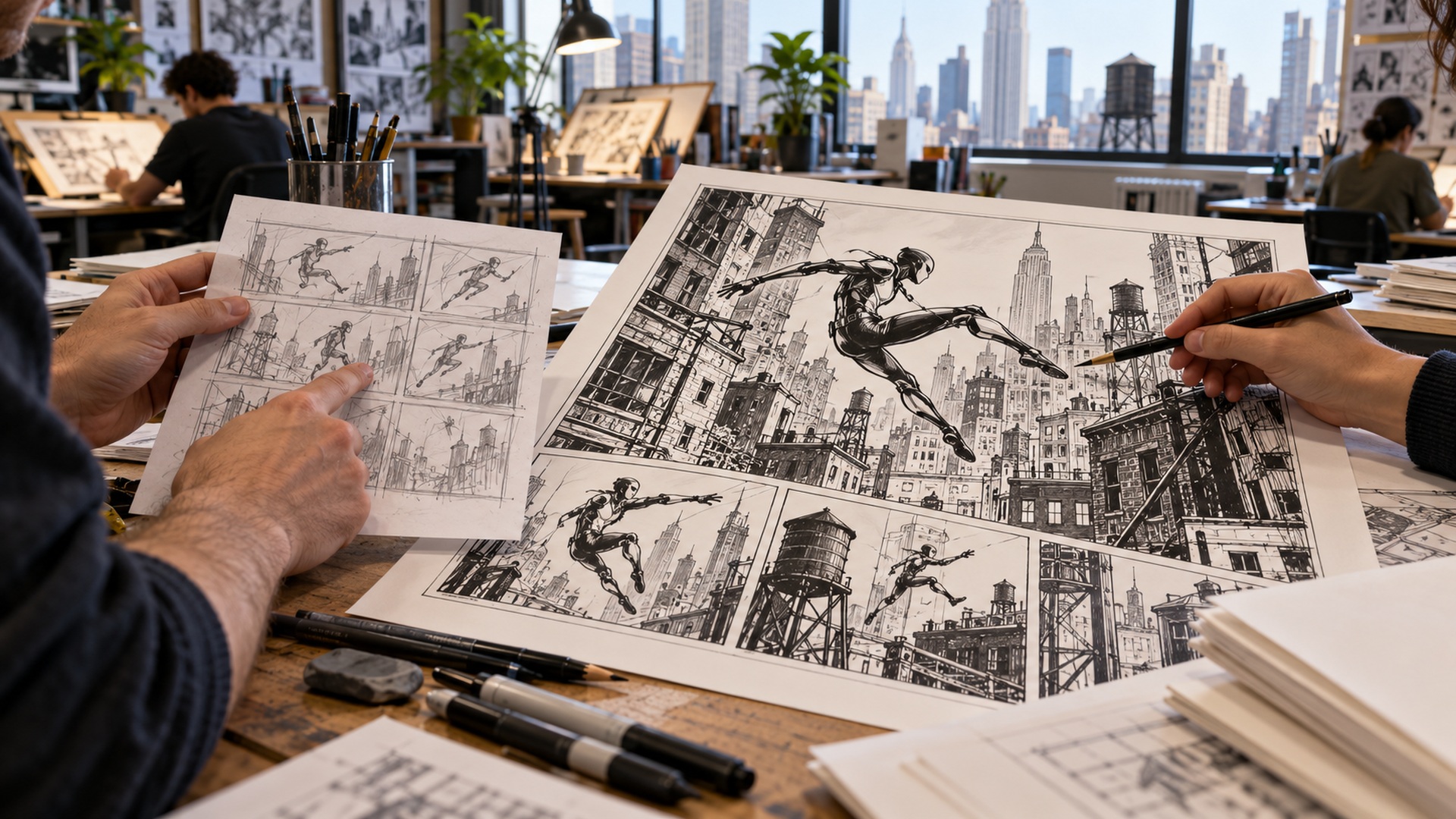
A hero reaches a doorway, but the artist discovers that the proposed viewpoint hides the object the reader must notice. Solving that small problem can change the composition, the timing of a reveal, and even the dialogue that follows. That is a useful starting point for looking behind Marvel Comics: the story continues to develop as it becomes a page. Its makers do not merely move an unchanged idea through a row of interchangeable jobs. Marvel’s history includes different ways of distributing that development, most famously the plot-first practices associated with Stan Lee, Jack Kirby, Steve Ditko, and other collaborators. Contemporary projects also reveal varied relationships between scripts, drawing, editing, and production. Public interviews, original artwork, and actual issue credits provide evidence of those relationships. They offer a more reliable view than imagining that every Marvel team follows one timeless office procedure or that a famous publishing slogan explains who created everything.
A: No. The amount of plotting and the distribution of narrative decisions varied.
A: Yes. Visual sequencing and plotting can be substantial narrative work.
A: No. Viewpoint, performance, spacing, and transitions still need interpretation.
A: Emotion and causal links must remain readable with fewer verbal explanations.
A: It provides a participant's perspective that should be compared with other evidence.
A: No. Public identity is different from the physical arrangements of particular assignments.
A: Drawing, color, lettering, and continuity references may all depend on the existing version.
A: They describe different assignments and should be checked separately.
A: A narrower focus can reduce historical scope while retaining substantial storytelling demands.
A: Compare its credits with available scripts, artwork, and project-specific creator accounts.
Start With the Records We Can Actually Examine
A finished comic is the clearest public record of what reached readers, but it does not disclose every conversation that produced it. Scripts, layouts, margin annotations, interviews, and editorial recollections provide additional evidence. Each answers a different question. A script can show a proposed scene, while a later interview may explain why the published version took another form.
These records also have limits. A participant may remember a demanding assignment differently years later, or discuss only the part of production most relevant to an interview. Comparing sources helps distinguish a documented decision from a plausible reconstruction. A behind-the-scenes account should make that distinction visible rather than claim access to meetings no public evidence describes.
Marvel’s conversation with writer Paul Allor provides a useful example of specificity. He discusses structural demands and names collaborators involved in the work. That is the scale on which production becomes intelligible: a particular format, a particular team, and a problem that changes how the story must be organized.
The Cover and the Opening Perform Different Jobs
A cover needs to make an encounter inviting before the reader has entered it, while an opening page begins the actual management of information. The two can emphasize different aspects of the same comic without becoming unrelated promises. A dramatic group image might attract attention through scale, whereas the story begins with one person discovering that something is wrong. Understanding those separate jobs helps readers appreciate why a cover artist can contribute strongly to a book without drawing its interior narrative. It also makes the relationship between publicity and storytelling easier to assess: the attractive image should create an expectation the issue can meaningfully address, rather than be mistaken for a literal record of every event inside. The finished publication is therefore assembled from contributions aimed at related but distinct moments of the reader’s attention.
Comparing cover and interior credits provides a practical way to see that distinction. Look at which figures dominate the cover, then notice whose perception organizes the first scene and how quickly the advertised premise becomes relevant. This comparison does not reveal an undocumented commissioning schedule, and it cannot establish why an editor selected a particular image. It can show how the published object prepares and redirects attention, including a deliberate contrast between spectacular anticipation and an intimate opening. A reader may enjoy that shift or feel that the promise was poorly matched, but either judgment becomes more useful when it names the relationship being examined. The cover is part of encountering a Marvel comic, while its visual priorities need not be identical to those of the sequential pages that follow.
The Marvel Method Describes a Family of Arrangements
The familiar historical outline is that a plot or story discussion could precede the penciled pages, with dialogue and captions added after the visual sequence existed. The amount of material supplied at each stage varied, as did the artist’s role in developing events. Calling this the Marvel Method is useful shorthand only if those differences remain visible. An artist deciding what happens between broad plot points is contributing to narrative construction, not merely decorating completed prose. The Kirby Museum’s examination of accounts of the method demonstrates why questions of process and credit require evidence rather than a convenient single-author legend.
Drawing First Changes What the Next Collaborator Receives
When dialogue follows drawn pages, the writer responds to visible performances. An expression may suggest hesitation that an outline did not specify, or the space between figures may make an intended joke feel cruel. The available balloon area also becomes concrete. Words must fit a sequence with actual proportions rather than an imagined page that can expand without cost.
This arrangement can create productive discoveries, but it can also produce disagreement about what a panel means. If the artist intends one motive and the dialogue supplies another, the finished page contains the consequences of that difference. Historical discussions of Marvel therefore need to distinguish the existence of collaboration from the fairness or clarity of its recognition. A method can generate extraordinary comics without automatically resolving questions of responsibility.
A Full Script Still Leaves Visual Storytelling to Do
A script can specify pages, panels, actions, captions, and dialogue before drawing begins. That supplies a different starting point from a short plot, but it does not eliminate interpretation. A sentence describing a worried face can become a close view, a distant posture, or a reflection. Those choices affect what the reader knows and how intimately the character is encountered.
Marvel’s interview with Phil Noto discusses his response to scripts and characterization. Such testimony helps replace the vague idea of an artist following instructions with a more concrete account of reading and visualizing. The same written action can support several workable images, and selecting among them is part of making the comic.
Page density creates another negotiation. A script may propose several actions that cannot convincingly occur in one still image. Separating them requires more space, while combining them may hide the causal link the scene depends on. The solution can involve revising the words, simplifying an action, or changing how the page allocates its attention.
Neither plot-first nor full-script practice guarantees a stronger result. The useful question is whether the collaborators understand their responsibilities and can communicate about discoveries. A detailed script may welcome substantial artistic invention; a brief plot may leave an artist with confusing expectations. Process labels identify starting arrangements, while the quality of the relationship determines how flexibly those arrangements can serve the actual pages.
Near-Silence Makes the Artist’s Narrative Decisions Obvious
One especially revealing example comes from Marvel’s discussion with Carmen Carnero, Collin Kelly, and Jackson Lanzing about Captain America: Sentinel of Liberty. Carnero describes responding to an almost silent issue whose emotions had to carry unusual weight. A passage with fewer words still requires writing, but it makes the drawing’s responsibility for rhythm, reaction, and inference particularly visible. The reader must recognize what a person notices, understand why a pause matters, and connect one image to the next without continuous verbal explanation. Silence increases the need for coordination rather than removing a job from the team.
A Shared Universe Adds Dependencies Beyond One Issue
A Marvel comic may use characters whose lives continue in other titles. That creates questions about what the protagonist knows, which relationships are active, and what consequences can carry forward. Coordination supports the reader’s ability to believe that an event matters. It need not mean reciting every earlier appearance before a scene can begin.
Kurt Busiek’s account of researching Marvel history describes the demands of placing stories among an expanding catalogue. His examples show why scope matters. A project covering a broad historical period has different research burdens from a focused episode, even when both use familiar characters.
For an ongoing title, practical questions can be equally specific. A costume change may need to appear consistently, an injury may limit an action, or an event elsewhere may change a supporting character’s availability. These are illustrative coordination problems, not claims about a private Marvel checklist. Their importance is that production decisions connect fictional continuity with files, references, and communication among real people.
Finishing the Art Requires More Than Preserving an Outline
Inking, coloring, and lettering each alter how the narrative is encountered. A stronger black shape may clarify a silhouette; a controlled palette can keep a crowded battle readable; balloon placement can establish the order of an argument. Teams divide those responsibilities differently, and one person may handle several. The final credits are therefore a better guide than assuming every issue passes through an identical set of separate workers.
These contributions also interact. A color effect that looks clear on an unlettered panel may compete with a caption in the assembled page. A large sound effect can require space the drawing did not anticipate. Seeing the combination allows the team to evaluate the actual reading experience, including details that no individual file could reveal by itself.
The Famous Bullpen Is Not a Floor Plan for Every Era
Marvel’s public identity has long encouraged readers to imagine a lively community of makers. That sense of personality can be welcoming, but it should not be mistaken for evidence that all contributors worked in the same room or under unchanged conditions. Freelance relationships, remote communication, different editorial groups, and changing tools complicate the picture. A historical nickname tells us something about how the publisher addressed its audience; it does not establish where a penciller sat on a particular day. Understanding the distinction allows readers to enjoy the public mythology while still looking carefully at the labor behind it.
Approval and Revision Need a Specific Problem to Solve
A revision request becomes useful when it identifies what the reader is missing. If a rescue looks like an attack, the issue may be a viewpoint, an expression, or a transition. Asking for more excitement does not identify which one needs attention. Clarifying the narrative problem gives the relevant collaborators a way to propose a solution without assuming that every correction must be drawn in advance by an editor.
Timing matters because a change can affect several completed stages. Revising a line of dialogue may be straightforward, while moving an entire scene can require new drawing, color, and lettering. The team needs to understand the consequences before treating a late change as trivial. Readers seldom see these negotiations, but the apparent ease of a published scene can depend on their careful resolution.
Read the Credit Page as a Guide to the Finished Object
An issue’s credit page can distinguish writer, penciller, inker, colorist, letterer, and editor, but the precise labels vary. Sometimes a creator handles several visual roles. Sometimes a story has additional contributors or a special format. Cover credits can also differ from interior credits, so a striking promotional image should not be used to guess who drew the narrative pages.
Marvel’s catalogue entry for Major X #6 is a concrete example of overlapping roles: it credits Rob Liefeld across several creative tasks and separately identifies other contributors. The point is not to make that issue a universal model. It demonstrates why actual project evidence is more informative than a diagram with one compulsory person in every box.
Looking behind Marvel Comics ultimately means following how decisions become visible. An outline becomes action, a script becomes performance, and a coordinated set of files becomes a readable issue. Public sources cannot reveal every private exchange, but they can show that the finished story emerges through interpretation at several stages. Recognizing those contributions makes the superhero adventure richer: the apparently effortless movement across a rooftop contains a great deal of human judgment.