
A Finished Comic Begins With a Series of Manageable Decisions
Imagine a short comic about a cyclist who finds a dropped mitten and tries to return it to a departing bus passenger. The idea is small, but making it readable requires many decisions: who notices the mitten, how the bus’s departure becomes clear, which action deserves a panel, where the words fit, and how the finished pages reach a reader. Those decisions form a practical production sequence. Comics can be made by one cartoonist or by teams that divide writing, drawing, inks, color, lettering, editing, and production. The stages may overlap, but the underlying questions remain useful. This guide follows the work from an initial brief to a finished object, emphasizing what each stage needs to deliver before expensive detail makes changes harder. The goal is a readable, complete comic whose scale matches the people, time, and resources actually available.
A: Some use outlines, visual development, or other arrangements; the next contributor still needs a usable brief.
A: Rough pages expose communication and space problems before finishing makes changes costly.
A: Yes. Combining roles does not remove the underlying decisions those stages address.
A: One collaborator may expect tight forms while another expects the finisher to complete loose layouts.
A: Early enough to shape page design and production specifications.
A: Only assembly reveals sequence, page turns, missing material, and whole-object navigation.
A: It lets edge-to-edge artwork extend beyond the cut line despite trimming variation.
A: The actual delivered format needs testing on the intended reading setup.
A: Their account of what happened exposes assumptions the creators may unconsciously supply.
A: Preserve editable sources and the actual released version as clearly distinguishable records.
Define the Smallest Complete Version of the Project
Start by deciding what is being made: a one-page exercise, a short folded booklet, a chapter, or a longer book. Page count, intended audience, color approach, and delivery format affect every later stage. A short story for a phone screen may need different navigation from a printed spread. A full-color book requires work that a black-and-white miniature can avoid. These are creative choices with production consequences, so they should be made before the project accumulates finished pages that no longer fit its practical limits.
For the mitten story, define the essential experience as a small act of attention followed by an attempt to help. The cyclist’s entire childhood and the bus passenger’s biography are unnecessary unless they change that experience. Establish a realistic endpoint and a list of required deliverables, including any cover, credits, and export files. A clear scope gives the team a way to evaluate new ideas: does the addition strengthen this complete short comic, or does it quietly turn it into a different project?
Turn the Idea Into Actions That Can Be Drawn
A comics script needs to distinguish visible action from information supplied through language. The cyclist cannot notice the mitten, pick it up, cross a road, and hand it through a bus window as one unchanged still image. Several actions require a sequence or a carefully selected moment that implies what surrounds it. Begin by identifying what the reader must understand, then decide which facts can be shown and which genuinely need words.
A full script may specify pages and panels, descriptions, dialogue, and captions. Other teams work from a plot outline or develop words after an initial visual pass. There is no universal script document that every professional follows. Comics Experience’s script archive provides authorized examples of different working approaches. The relevant principle is that the chosen document communicates enough information for the next stage without pretending to be the only legitimate method.
Descriptions should separate a panel’s crucial event from optional decoration. If the mitten must be visible, say so; if a specific traffic light is needed to explain why the cyclist stops, establish it. A demand for a detailed face, complete vehicle, distant crowd, and readable object in a tiny panel may be impossible to satisfy at once. The script is an opportunity to discover that conflict while changes are still inexpensive.
Read dialogue aloud and estimate how much space it will occupy. A long explanation can overwhelm a simple physical action, and a repeated statement can tell the reader something the picture already makes clear. This does not mean that comics must use few words. It means that the amount and kind of language should belong to the intended rhythm. The script’s job is to make the next stage possible, not to prove that the writer has already solved every visual decision alone.
Thumbnails Test the Reading Before the Finish
Thumbnails are small rough page plans that test panel arrangement, pacing, orientation, and room for text. For the mitten story, they should establish where the cyclist stands, which direction the bus moves, and why returning the object requires effort. A rough circle can stand for a head if it allows the action to be checked. The purpose is not to impress a viewer with anatomy or rendering. It is to expose a confusing jump, a weak pause, or a panel whose important information has no room. Scott McCloud’s Making Comics is one creator’s sustained examination of the visual decisions involved. At this stage, moving a panel or replacing a viewpoint is a practical improvement rather than a painful loss of hours spent polishing the wrong arrangement.
Develop the Drawing Without Losing the Tested Sequence
Layouts and pencils give the rough plan usable bodies, environments, expressions, and object relationships. Reference can help establish a bus interior or a bicycle’s structure, but the image must still work as storytelling rather than as a collection of accurately copied objects. Keep the important mitten large enough to identify and make the cyclist’s line of sight clear. If a new camera angle weakens the established direction of travel, solve that problem before celebrating the improved perspective.
Character and location references become especially useful when several pages or artists must remain consistent. The mitten’s shape should not change accidentally between the discovery and return. The bus door must occupy a plausible location when the viewpoint changes. A simple reference sheet can preserve these facts without requiring every panel to repeat the same pose. Continuity serves understanding; it does not require visual monotony.
Some artists move directly from rough layouts to finished line art. Others use a distinct penciling stage and a separate inker. The correct handoff depends on the arrangement: loose layouts leave more drawing decisions to the finisher, while tight pencils may define most forms in advance. What matters is that both people understand what remains open. The production plan should describe the expected state of the page, rather than assuming that the word pencils means the same thing to every team.
Finish the Visible Forms, Then Establish the Color Approach
Inking or another finishing method turns the drawing into marks that can survive its intended reproduction. That process involves line weight, black shapes, texture, and decisions about how much detail to retain. A tiny bus passenger’s expression may need simplification at publication size. Finishing should preserve the sequence’s clarity instead of treating each panel as an unrelated illustration. A painter or digital cartoonist may combine stages, but the need for readable forms does not disappear.
Color then contributes its own organization of attention and atmosphere, whether handled by the artist or another practitioner. The mitten might need to stand apart from the pavement without becoming implausibly luminous. Establish the broad treatment early enough that the project does not reach its final pages before discovering an unmanageable rendering workload. A proof-sized sample is more useful than a highly enlarged demonstration that hides how the published comic will look. The aim here is to fit color into the complete workflow, with a known deliverable and room for necessary corrections.
Make Words Part of the Final Page
Lettering must be reviewed with the artwork rather than judged in an isolated text document. Balloons need an understandable order, readable text, comfortable interior space, and tails that identify speakers. A final plea shouted toward the bus cannot conceal the passenger’s response if that expression completes the story. Early rough balloon placement helps avoid the problem, but the assembled page still needs checking after the actual words and art arrive. Nate Piekos’s lettering conventions guide explains many recurring decisions. A one-person cartoonist may write and letter while drawing; a divided team may work at different stages. In either case, words are visible shapes that participate in the composition and need to be assessed at the size readers will encounter them.
Assemble the Deliverable With the Destination in Mind
Production brings the final pages, cover, credits, and other material into the required form. For print, obtain the actual printer’s specifications for dimensions, margins, bleed, page count, and file delivery. Bleed allows intended edge-to-edge artwork to extend beyond the cut line; a safe margin protects important content from that uncertainty. A folded booklet also needs a workable page count and correct sequence. Guessing these details from an unrelated project can create avoidable rework.
Digital delivery has its own requirements. A fixed-page comic, a continuous scroll, and a downloadable book offer different navigation and scale. A spread that depends on seeing both pages at once may fail when displayed as separate narrow images. Decide how the work should be read and test the exported object in that form. A source file that looks correct inside the creator’s application is not sufficient evidence that the reader will receive the same experience.
Maintain a clear distinction between editable source files and final delivery files. Name versions so that a corrected page cannot be confused with the copy it replaces, and collect the approved material in one identifiable final set. The practical purpose is simple: the person assembling or releasing the comic should not have to guess which image is current. This becomes especially important when dialogue, color, or a cover is revised after an early proof has already circulated.
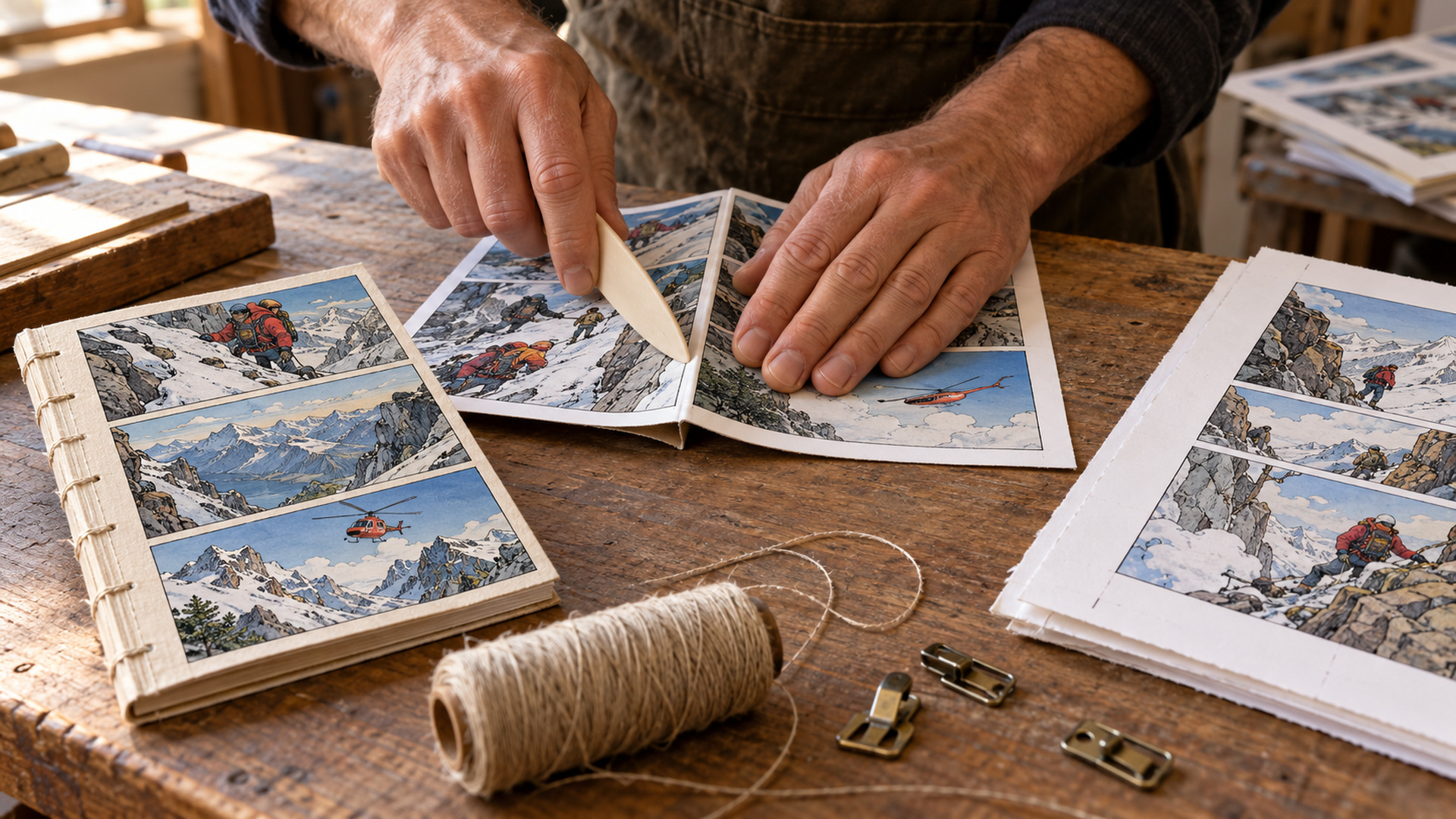
Cover preparation deserves a separate check because the object’s outside and inside may have different production requirements. A stitched miniature, a square-bound paperback, and a digital chapter do not necessarily need the same cover layout. Avoid calculating a spine from guesswork before the format and page total are settled. For the small mitten booklet, a folded dummy makes the outside, inside, and page sequence easy to inspect. For another project, follow its actual production instructions. The purpose is to finish the object being made rather than export a collection of individually attractive pages and hope assembly will explain itself.
Proof the Object a Reader Will Actually Use
A complete proof should be read from the opening through the final page without stopping to repair details mentally. Check page order, missing pages, small words, cropped faces, cut-off balloons, and any spread-dependent transitions. For the mitten story, ask an unfamiliar reader what happened before explaining the intended plot. If the reader believes the cyclist stole the object or cannot tell that the bus is leaving, the comic needs a communication fix rather than a defense of its intentions. A folded paper dummy can expose a page-turn problem, while an actual-device test can expose a digital navigation problem. These checks concern the complete experience, so they belong after assembly as well as during individual stages. Correct the cause, regenerate the deliverable, and inspect the corrected version.
Release the Comic and Preserve the Work Behind It
The release process depends on whether the comic is printed, posted digitally, submitted to a publisher, or distributed directly. Prepare the required cover image, description, credits, and accessible presentation with the same attention used inside the book. Check that the link or file opens and that any physical copies have the expected page sequence. A finished comic needs a practical route to readers; completing a production file alone does not guarantee that anyone can find or use it.
After release, preserve the editable material and the actual published version separately. Record useful lessons about scope, timing, unexpected corrections, and reader confusion while they are still specific. The mitten story may reveal that a silent response needed more space or that a complicated location consumed time without adding meaning. Those findings can improve the next project. Making comics is a sequence of decisions that become increasingly concrete, from a manageable idea to an object another person can read. A reliable workflow protects that movement while leaving different creators room to use different tools and arrangements.